
When I began hunting out the story of Ann Williams, Timaru’s first recorded European mother, I went on many side quests of curiousity about the world her son was born into. William Williams, born in 1856, holds the honour of being the first recorded European baby born in Timaru. Recorded and local are the key words here, because there were a few earlier bubs in the District, so here is side quest number 14... who else was born in Timaru around this time? Who were these early families building lives from scratch on our windy coast?
William wasn’t entirely alone in those early years, his older sister had immigrated with his parents from Ballarat Australia, so William had an older sister to play with. But in the Timaru town area, that was it for a few years. A few babies were born just before him to women like Elizabeth Rhodes who was living at the Levels Estate near Pleasant Point, and Margaret Hornbrook living at Arowhenua. And not long after William came another child, Laura Woollcombe was said "to be the third white child born in the area", who would grow up to make her own mark beyond Timaru.
But first, there was her father: Captain Belfield Woollcombe, an English gentleman who arrived in Timaru in 1858, when there were only two houses in the settlement. He lived in a literal shed on the beach, insulated with wool bales. His arrival brought with it a surge of civic energy—he became Timaru’s first magistrate, immigration officer, harbourmaster, and more. He was also the first church warden of St Mary’s Anglican Church, helping to build the original wooden structure that stood where St Mary’s still serves its community today.
Belfield later upgraded from the beach to a cob hut near what is now Te Weka Street, before finally establishing a substantial homestead on 87 acres overlooking the Waimataitai estuary—an area we now call Ashbury Park. That home, named after his English birthplace, is long gone, but the English trees he planted still rustle in the southern end of the park, tangible relics of Timaru’s colonial ambitions.
In 1861, Belfield married Frances Fendall, daughter of the Rev. Henry Fendall of Heathcote, Christchurch. Their honeymoon was fittingly rugged—a three-week journey to Timaru by bullock cart. It’s hard not to imagine the landscape they rattled through: dusty, wind-blown, raw with promise. Their first child, a daughter, was the third European baby born in Timaru—a birth that added another chapter to our town’s cradle-roll of firsts.
That child was Laura Russell Woollcombe, born in 1862. And what a life she lived.
Laura became a trailblazing nurse, one of the first New Zealand women to train under Florence Nightingale’s influence. She served for nearly three years during the Boer War as sister-in-charge on a British Army hospital train, enduring shellfire, flooding, and disease in South Africa while caring for the wounded with courage and humour. Her letters home—published in the Timaru Herald—offer gripping accounts of her service, from bridge-crossings under fire to sharing cake and cocoa with soldiers under canvas.
She returned to Timaru after retirement, and died in 1948, aged 86. Her obituary remembered her as "a gentle lady whose grace of manner, brightness of outlook, and kindness of heart... never dimmed."
What I love most about the Woollcombe story is how it reminds us that Timaru’s history isn’t just found in museums or plaques—it’s rooted in the soil, hidden in the names at cemeteies, of parks and streets. Ashbury Park was once the front yard of the old Woollcombe's home.
We often hear history is written by the victors... well here in Timaru, it’s can also be remembered in small details: a limestone baptismal font now tucked in the chapel at St Philip’s, trees planted by settlers who once hosted bishops on cob floors, the long journey of a bullock cart honeymoon.
And so, in seeking out the story of one mother Ann Williams... I found myself tracing a much broader lineage of women, families, and children who built lives here, one blanket, one birth, one act of service at a time.
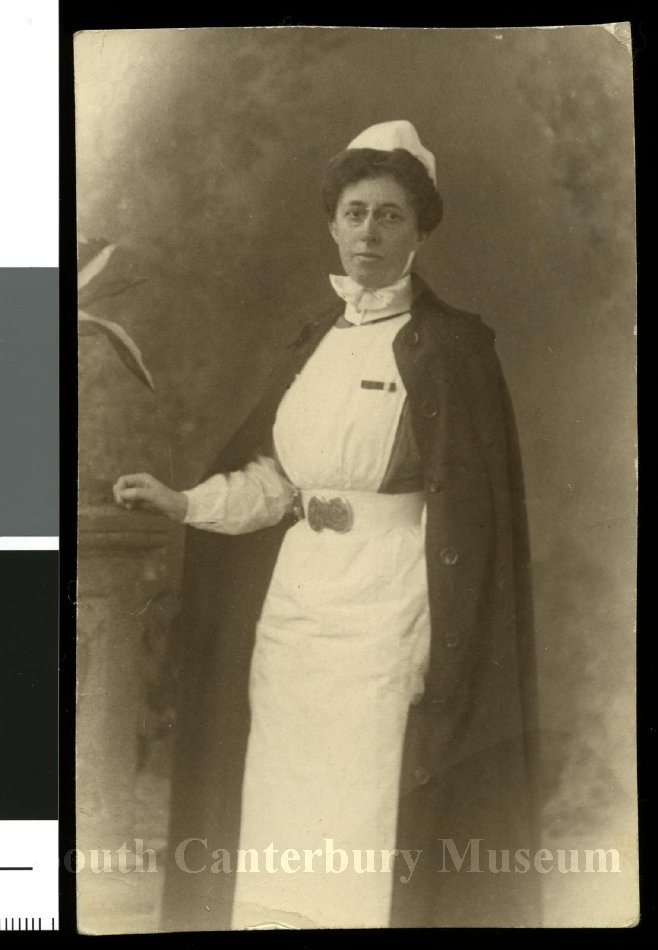
Postcard portrait of Miss Laura Russell Woollcombe, daughter of Captain B Woollcombe, circa 1899. Handwritten in pencil on the verso is the subjects name and "in Army Nursing Service uniform". The standard divided verso also credits production to "H. Craven, 46 Hall Lane, Armely, Leeds". .Laura Woollcombe - South Canterbury Museum 3366

1890-910 - The home of Belfield Woollcombe and family at Ashbury, Timaru. Bears the photographer's impression in the lower right corner of the mount. Woollcombe House on Ashbury - South Canterbury Museum 2022042007

Eliot, Whately. 1874, Mr. Woollcombe's house, Ashbury, Timaru, N.Z., October 1874 , viewed 22 November 2024 http://nla.gov.au/nla.obj-138582421. Out of Copyright. Creator Date of Death is Before 1955

Timaru from the Air when Waimataitai Creek still ran through what is today Ashbury Park. You can see how close the Caroline Bay Tea Rooms used to be to the sand. For many of the aerial photographs, while Doug Mill was piloting the plane his wife Audrey was leaning out of the open cockpit with a camera. Between 1927-1937. Auckland Libraries Heritage Collections FDM-0690-G - Creative Commons Licence: Attribution CC BY

A view from Edward Sealy’s House (just east of Craighead Diocesan School) looking towards the Waimataitai Lagoon in 1873. On the left, the small bridge crosses Athol Place. In the middle distance, you can see what is now Ashbury, with Ashbury Park situated behind. To the right, the original "Ashbury" stands—home to Belfield Woollcombe. The park was once known as "Woollcombe’s Paddock," and the surrounding grounds were informally referred to as the "Waimataitai grounds" by rugby players in the 1880s and 1890s. Edward's son, Edward Percy Sealy, represented South Canterbury in rugby in 1900. The location of the original house now lies within Ashbury Park, where the Ashbury Croquet Club is based. The house would have stood on the upper field, where Captain Belfield Woolcombe’s residence, ‘Ashbury,’ was located in the late 19th and early 20th centuries, before being demolished around 1914.

Section on the map showing the stream running through what is today Ashbury Park. The stream now runs through a storm water drain under the feild. Section of An early map of Timaru in 1860. Courtesy of the National Library. Archives New Zealand/Te Rua Mahara o te Kāwanatanga. Christchurch Office. Archives reference: CH1031, BM 245 pt 2, R22668176

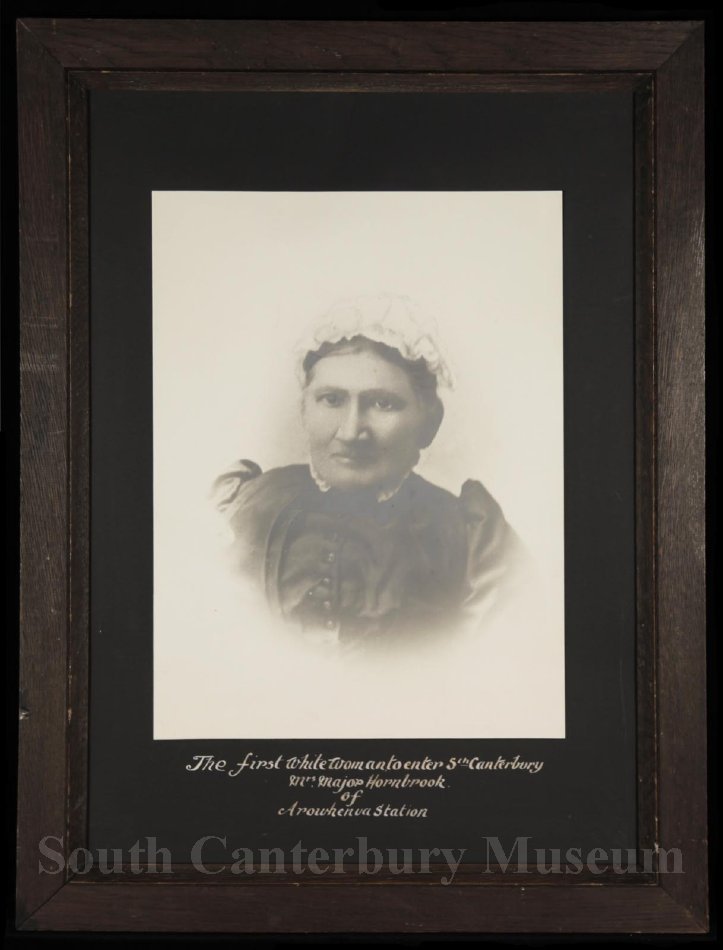
"Mrs Major Hornbrook of Arowhenua Station. Photo from the Burnett Collection. A portrait identified as "The first white woman to enter South Canterbury, Mrs Major Hornbrook of Arowhenua Station". Bears the title on the mount below the print and the label of Havelock Williams Art Studio on the verso. Note that Margaret Hornbroiok has been recorded as the first white woman to enter South Canterbury, but she was married to William Hornbrook, not his brother, Major Alfred Hornbrook."
- First "white woman" to enter South Canterbury in February 1854.
- Her husband, William Hornbrook, managed his brother Alfred’s Arowhenua Station.
- They brought two daughters, one of whom was Caroline.
- In 1854, a son, William Richard (known as Richards Hornbrook), was born—the first white child in South Canterbury.
- Mrs. Hornbrook mentioned in a letter that they left many old relics behind when leaving Arowhenua Station, and she did not know what happened to them.
- Rescued a traveler from drowning just three days after giving birth.
- Lived ten miles from The Levels, helping break isolation for the Rhodes family.
J B Hamilton, Letters Found in Timaru Give Account Of Pioneering Life in South Canterbury (06 April 1963). Aoraki Heritage Collection, accessed 05/03/2025, https://aorakiheritage.recollect.co.nz/nodes/view/5244
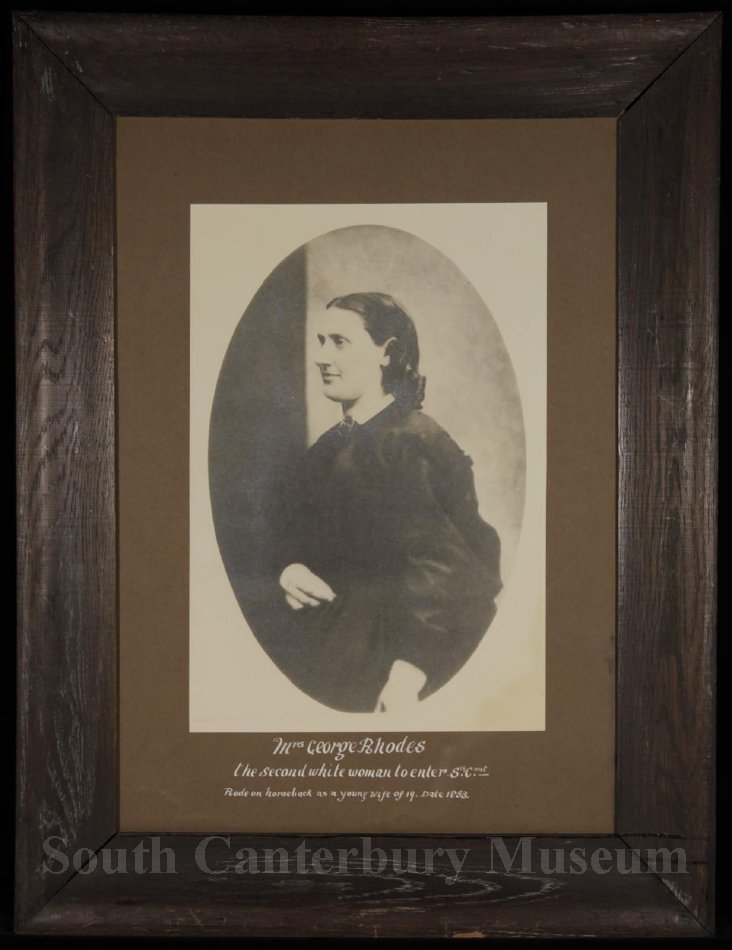
Elizabeth Rhodes the second white woman to enter South Canterbury. Rode on horseback as a young wife in 1853 - South Canterbury Musuem 2015154032
Elizabeth Rhodes
Early Life and Arrival in New Zealand: Elizabeth Woods arrived in New Zealand aged 19, on Christmas Day, 1853. She came as a governess to the Scott family. Through family connections in England, she knew the Rhodes brothers, and married George Rhodes on 31 May 1854. Marriage and Early Settler Life: She described her wedding in a letter to her brother, recalling: “It was a very wet day, but... we had about 35 to the breakfast, after which we rode off on horseback, to Sumner, a very small but pretty place where we stayed ten days.” Celebrations included a feast for local Māori and tar barrels blazing on the bay at night. Elizabeth then undertook a week-long horseback journey to Timaru, camping in tents overnight. Pioneer Woman’s Role: She needed resourcefulness, which she embraced. Managed a large vegetable garden and orchard to supply food for: Her own family, Employees, Neighbours, Passing visitors. Keeping food supplies reliable was a key challenge for pioneering women. Elizabeth also: Reglazed windows. Repaired children’s boots and shoes. Elizabeth had six children with George Rhodes, some born at Purau’s luxurious homestead. She sometimes relied on a Māori midwife. After George died, Elizabeth moved to Timaru. In 1867, she married Arthur Perry and had five more children. Later lived at Beverley. Died in 1890, aged approximately 54.
Before the construction of the harbour breakwater there was a continuous shingle beach stretching from Caroline Bay to Washdyke. The rocky headlands we see today at Benvenue and Dashing Rocks did not exist when Europeans first settled in Timaru. The Timaru coast from Patiti Point to Dashing Rocks was a line of cliffs cut by gullies to form a shoreline of small headlands and bays. All of the beaches were steep and shingly. Beach gravels from the rivers and cliffs of South Canterbury were transported northwards along the shore by wave currents. They travelled uninterrupted around Timaru’s irregular coastline up to Washdyke and the coast of the Canterbury Bight.
Begun in 1878 and with many additions since, the harbour breakwater has been the backbone of Timaru’s growth from an isolated whaling station into a small city. Before the construction of the breakwater, cargo had to be unloaded from ships moored out to sea in deep water and transported to the shore by smaller boats through the dangerous surf that still pounds the Timaru coastline today. This was a time consuming and risky business. The construction of the port may have created a safe haven for shipping but over the course of only a very few years it completely changed the shape of the Timaru shoreline.
Henry Sewell wrote the year that Timaru was proclaimed a town in 1856, described it as a miserable apology for a Shipping place without wood or water... "I slept one night at Timaru all alone, in a solitary and deserted house on the sea shore, lately occupied by Rhodes as a Station house. ... I saw all which was to be seen of Timaru, which gave me no favourable impression. It is desolate and dreary in the extreme, so far as appearance goes; and for a Shipping place it is a miserable apology, for a Shipping place without wood or water! A wild open roadstead with a reef of rocks covered with kelp which breaks the force of the waves so far that at certain times boats may come in in smooth water. As specimen [of despondency] Macdonald and Rhodes chartered a vessel from Lyttelton to take goods down to Timaru. The vessel was off the coast twice and dared not come in. That fact alone speaks volumes. The people there for upwards of six weeks & upwards she was beating up & down between Akaroa and Timaru. The upshot is, she could not land, and it was laid on. That is a delusion if ever there was something that will not pay. Steamer might do something. The people there fondly imagine that a Steamer will do the work. I should say that they are all deluded, and will remain so for years to come. Meantime, that Southern Country is all but inaccessible."
The book A History of Canterbury wrote after this early Timaru apraisal: In this sour appraisal of the outlook for Timaru the last sentence was most significant. South Canterbury was isolated and comparatively uninhabited. A few enterprising men had established themselves. They knew that their success depended on improved communications. Yet were not numerous enough to secure government action on their behalf. The speed of development was therefore practically governed by that of their bullock teams. Over the following three years, 1857–9, lumbering bullock wagons crept across the unroaded plains. One official, one store, an organized landing service, and, lastly, some population: Timaru acquired one government official and he became one official of all trades. This character, B. W. Woollcombe, the best known South Canterbury identity in the ‘sixties, served as the only resident magistrate and naval officer, the sole port and postal official in Timaru, but for four years the only embodiment of law and government between the Rangitata and Waitaki rivers.
- The Rhodes family transitioned from a totara slab homestead to a new house, planting trees brought from Purau, including:
- Apple, plum, cherry, walnut, peach, mulberry, filbert, and pomegranate trees.
- Gum trees and yew trees, which now form an archway over a "Cloth of Gold" rose tree planted by Mrs. Rhodes.
- 1843: George Rhodes arrived from England to manage a cattle station and operated a whaling station.
- 1851: George and Robert Rhodes, with some shepherds, set out to establish their Banks Peninsula runs, crossing the Rakaia River.
- 1851: They wrote to the Colonial Secretary, announcing they had taken possession of a run near Timaru, between the Rivers Opihi and Waihi.
- Homestead: Built a cob house in South Canterbury, the only dwelling between the Waitaki River and Lake Ellesmere, becoming a central station.
- Alfred Hornbrook: In 1853, Alfred Hornbrook arrived in Timaru to manage a station at Horauana, inland by the hills.
- 1854: Alfred Cox bought two licences for runs, shipping sheep and cattle to Lyttelton, then camping at Mount Four Peaks.
- 1854: Studholme arrived at Te Waimate Station, seeking an agreement with Chief Uru Uru, marking the establishment of a run from the sea to the Hook.
- Otain Station: Established by Annie Collier and others, stretching from the Hack to the Otaio rivers and from the sea to Hakeforamea Valley.
- Pareora Station: Developed by Warris and Innes, running from the Hunter Hills to the Pareora and Otaio rivers.
- Raincliff Station: Located between the Onihi and Opua rivers, spanning 30,000 acres.
- Charles G. Tripp: In 1855, Tripp moved to the Mackenzie country, discovering new areas for sheep and cattle runs, including the shores of Lake Pukaki and Lake Tekapo.
- Mt. Peel Station: Tripp and his friend started Mt. Peel station, seen from Christchurch by their fires.
- Mesopotamia Station: Samuel Butler consolidated holdings into this station, becoming a notable literary figure while living there.
- Mackenzie Country: In 1864, Andrew Burnett and others founded stations in the Mackenzie Plains.
- Mount Cook: In a spur of the moment decision, McRae named a station "Mount Cook" after applying for it in Christchurch.
- After working in water while dipping sheep at Purau Station, George Rhodes caught a chill and became seriously ill.
- His death was marked by the tolling of the church bell.
- Māori mourned him deeply, saying: "Tioti was a good man; he was like our own father."
- Mrs. Rhodes found managing The Levels station too difficult and agreed to sell it.
- She and her five children moved to Linwood House, near George Street.
- Early township struggles included: Scarce water supply – a crisis when a dog drowned in one of the two wells. Frequent shipwrecks, with the signal bell ringing for the rocket brigade. A devastating fire that destroyed half the town in an afternoon. The town expanded rapidly, replacing the Rhodes family's home with municipal offices, the Post Office, and a fire station.
Life at Beverley
After marrying Arthur Perry, Mrs. Rhodes moved to "Beverley," a grand home overlooking Caroline Bay.
Beverley had historic ties:
The whaling ship Caroline had brought supplies to Sam Williams there half a century earlier.
Mrs. Rhodes planted a Wellingtonia tree grown from a seed belonging to her first husband.
The tree is now enormous and visible from the sea.
Hoani Kahu, a respected Māori chieftain, frequently visited Beverley in his later years.
The white-bearded chieftain Hoani Kahu was a frequent visitor.
He would pick up one of the Rhodes children and joke, “Nice fat piccaninny—good to eat.”
The children, terrified, would flee, fearing he might take them away in his large bag to a Māori oven.
Wildlife and Conservation Efforts
When Mrs. Rhodes first arrived in South Canterbury, the area was full of wild pigs, dogs, paradise ducks, pukaki, kakas, and wekas.
As swamps were drained, many wild animals and birds disappeared, some nearly to extinction.
She worked to counter this by importing English birds.
Birds such as goldfinches, linnets, redpolls, hedgesparrows, skylarks, pheasants, yellowhammers, and starlings were introduced before the end of 1876.
Memories of The Levels
She remained deeply attached to The Levels station.
Frequently visited to check on the trees she had planted years before.
Recalled the early days:
The homestead’s small steps and sleeping platform for a maid.
Her baby was born in that home.
Māori visitors would often sit outside in the morning, surprising her as she emerged from her bedroom.
Legacy and Change
Mrs. Rhodes, the first white woman to cross the Canterbury Plains, saw massive transformation:
Grain and wool stores replaced her beachside cob cottage.
Railway sidings replaced areas where she once gathered stones.
A modern harbor stretched into the sea where whaling boats had once anchored.
Steel bridges made river crossings safer.
Wheatfields turned the region into “the granary of New Zealand.”
London buses advertised “prime Canterbury Lamb” as the world’s best.
She witnessed Canterbury evolve from a wilderness into a prosperous settlement.
Final Days
In January 1890, one of her children went to wake her—only to find she had passed away.
She had joined “the lone gray company, before the pioneers.”
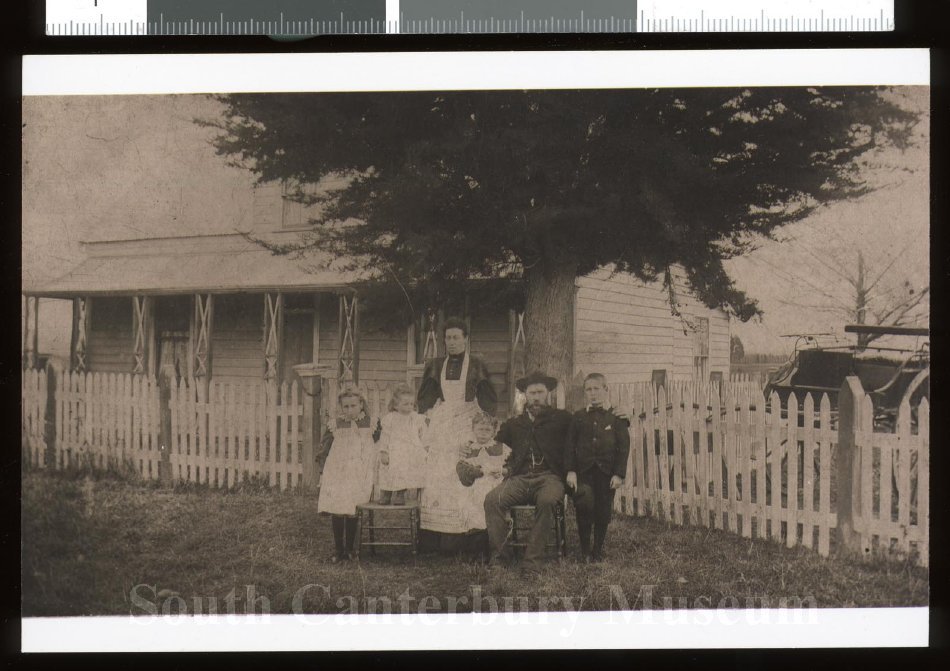
The family of Robert Cairns, who arrived in the Strathallan in 1859 aged two and a half, pictured in Amberley/North Canterbury in later life, circa 1898. Pictured are (from left to right): Elizabeth Jane (Cissy -later Mrs George Hatt), Rose Millecent, Jane (mother, nee Main), Margaret, Robert, and Robert (junior). Bears identifications notes on the verso.
Mary McHutchenson was the first white woman in the Mackenzie Country moving there in 1856.