
By Roselyn Fauth
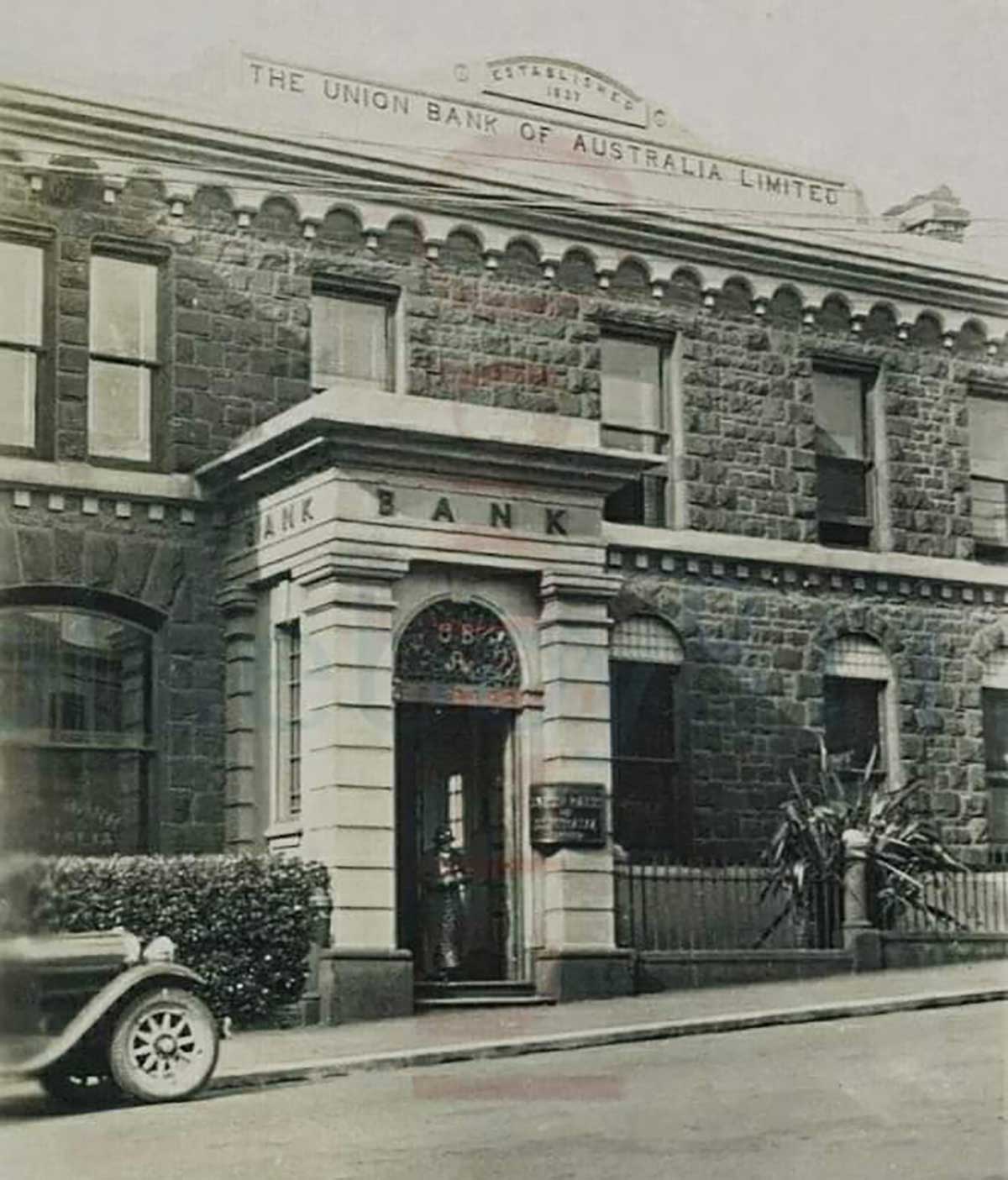
Former Union Bank of Australia (1877) at 119 Stafford Street, Timaru
When I walked through the old Union Bank of Australia building recently, I found myself imagining being in Charles Grierson’s shoes.
He was the first bank manager to step into this new bluestone bank when it opened on Stafford St in 1877, and lived upstairs, keeping watch over the safe.
Standing there during the recent renovation by Timaru District Holdings Ltd (TDHL), I felt unexpectedly connected to that earlier world.
The Union Bank story began far from Timaru. It issued its first prospectus in London in 1837 and became the first bank to operate in New Zealand, opening a branch in Wellington in 1840. By the time it reached Timaru in 1867, it was well established across the country and staffed here by a manager and six banking officers.

1909 Photograph taken by an unidentified photographer employed or contracted by 'The Press' newspaper of Christchurch.Stafford Street, Timaru, with carts, horses and people in the street. The Press (Newspaper) :Negatives. Ref: 1/1-008815-G. Alexander Turnbull Library, Wellington, New Zealand. /records/29944621
Grierson was in charge when the new building opened. The bank would remain in this spot for 74 years before merging in 1951 with the Bank of Australasia to become the ANZ.
The building was designed by Thomas Roberts, a Timaru architect who trained as an engineer in England before emigrating to Canterbury in 1870.
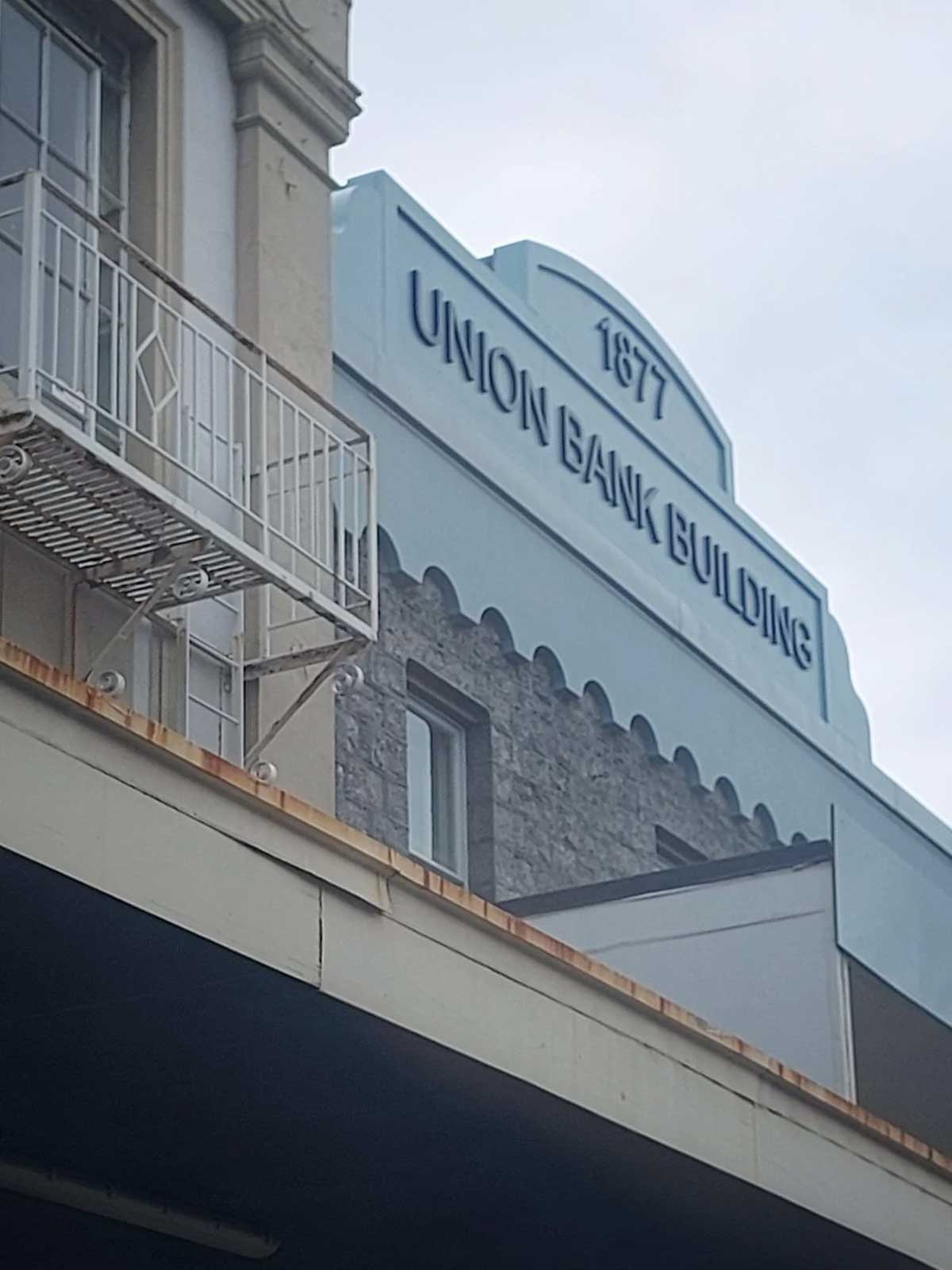
The former Union Bank of Australia in Timaru's Stafford St, which dates back to the 1870s has been made over. - Photography By Roselyn Fauth 2026
He later designed Sealy House, now Shand House at Craighead Diocesan School. The contractor was Thomas Machin, who would later practise as an architect.
Together they created a Victorian commercial classical building with real presence, constructed in Timaru bluestone with cement plaster, brick, slate and corrugated iron. The project cost about £3000, a significant investment for a town still recovering from the devastating 1868 fire that destroyed much of its wooden CBD. It was a building that needed to look trustworthy, and it did.

Over the years, the façade evolved. A suspended veranda was added, and in the 1950s and 1960s modern shop fronts were built in front of the original structure. This is the building I remember growing up in Timaru, where I bought clarinet reeds and Theatre Royal tickets from Newman’s Music Store.
Seeing the scaffolding come down to reveal the restored bluestone was a real thrill. Removing the later plaster has brought back a strong sense of heritage character that anchors the whole streetscape.
Inside, several original features have survived. Fireplaces, a koru stair banister, columns with Corinthian capitals, and the wonderful old safe door that still opens into the strongroom. These details make it easy to imagine those early banking staff stepping between counters and ledgers.
TDHL purchased the property in 2018. In 2023, they committed to strengthening and restoring it to support and complement the south end redevelopment.
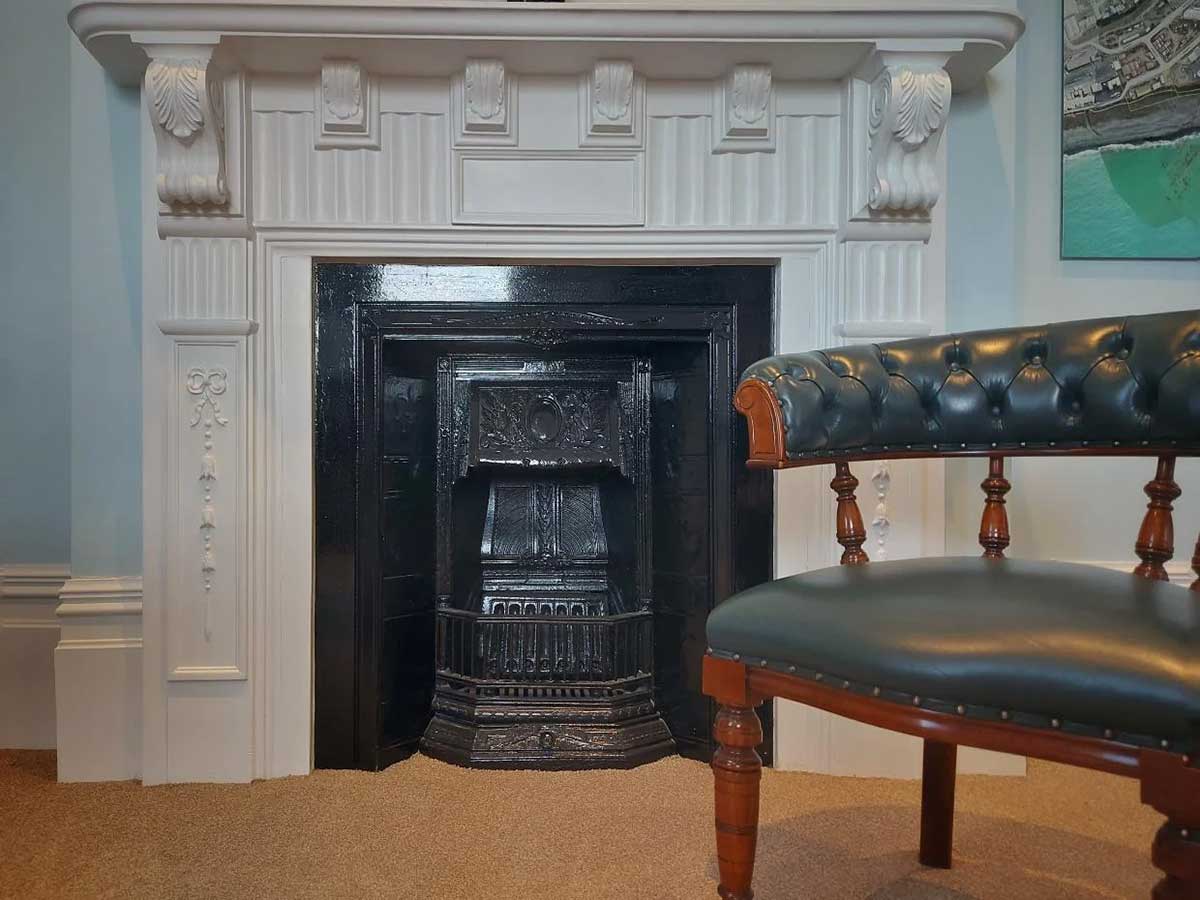
Some of the original features are retained in the former Union Bank of Australia in Timaru's Stafford St, which dates back to the 1870s. - Photography By Roselyn Fauth 2026
The former bank manager’s residence on the first floor has been the TDHL office since 2024, and the ground floor is now home to Venture Timaru.
TDHL general manager Frazer Munro showed me around upstairs and said it had been a fantastic project to be involved with, especially reaching the completion of the façade restoration. The high ceilings and heritage elements in all the rooms create a calming and inviting atmosphere.
Venture Timaru operations and destination manager Di Hay told me what a privilege it was to now be located in this heritage building, where the careful renovation process has celebrated the past and also the present, with some nice modern touches.

The Union Bank opened in Timaru in 1877. Detail of the staircase - Photography By Roselyn Fauth 2026
Buildings like this help us understand where we have come from and who we are today. Keeping them alive means allowing them to evolve while honouring their past. Everyone involved should feel proud. It is wonderful to see this place humming with life again at the south end of Stafford St.

The banks of Timaru (2) (29 Aug 1981). Aoraki Heritage Collection, https://aorakiheritage.recollect.co.nz/nodes/view/532
Notable Characters Associated with the Bank
Alfred Beaumont Smallwood
- Alfred Beaumont Smallwood worked as a teller at the Union Bank of Australia in Timaru in 1869.
- On 18 December 1869, he joined several passengers travelling from Timaru to Dunedin aboard the coastal steamer Maori.
- Among the passengers was James Melville Balfour, a prominent Marine and Civil Engineer for Otago.
- Due to rough weather, passengers first travelled from shore in a small boat to reach the steamer anchored offshore.
- The boat encountered difficulties, taking on water and sheltering near a buoy for almost an hour.
- Signal flags from shore reportedly instructed the boat to return, but the signals were either not seen or not acted upon.
- The Maori later sent its own boat to transfer the passengers safely from the stranded vessel.
- While passengers successfully transferred to the steamer’s boat, a large easterly swell struck as it approached the ship.
- The boat capsized, throwing all occupants into the sea.
- Most passengers were rescued using ropes from the Maori and assistance from the harbour lifeboat.
- Alfred Smallwood and James Melville Balfour were unable to maintain their hold and both drowned.
- At the time of his death, Smallwood was 23 years old.
- He had planned to spend Christmas in Dunedin with friends.
- Contemporary accounts described him as a well-respected young man who was highly regarded by those who knew him.
- James Melville Balfour had been in Timaru inspecting work on the district’s first concrete breakwater, which he had designed..
- Balfour had been travelling urgently to attend the funeral of fellow surveyor T. Patterson in Dunedin.
- Tragically, Balfour died before reaching Dunedin and was buried around the same time as the funeral he had intended to attend.
- The breakwater Balfour designed was later damaged and largely destroyed by storms in early 1870, highlighting the engineering challenges of the period.
Source: https://timarutrails.stqry.app/en/story/23413
Edward Henry Tate
- Edward Henry Tate was born in 1829 and died in 1882.
- He arrived in Timaru in 1868 to work as Manager of the Union Bank of Australia.
- Tate was regarded as a respected businessman in the town.
- He was also a friend of Archdeacon Harper of St Mary’s Church.
- Tate and his family lived at 18 Elizabeth Street, Timaru.
- After leaving the bank, he became a land broker.
- He first went into partnership with David M. Ross.
- Tate later entered into partnership with Thomas Hall.
- Hall later became notorious for the poisoning of Captain Henry Cain and the attempted poisoning of his wife, Kate Hall.
- In August 1882, Edward Tate went missing.
- Later stories connected Tate’s death with Thomas Hall, helping create local mythology around the case.
- In My First Eighty Years, Helen Wilson claimed Tate’s body was found at Saltwater Creek with “a bottle of poison by his side”.
- Wilson also wrote that the business affairs of Tate and Hall were found to be in confusion.
- Later research suggests a different account.
- At the inquest, Godfrey Ellis stated that his children found Tate’s body near Jack’s Point.
- The inquest evidence did not mention a bottle of poison.
- Dr Hammond examined the body and gave medical evidence.
- The jury concluded that E. H. Tate died from a fit of serious apoplexy.
- More than eighty years later, in 1964, Tate’s name appeared again in the Timaru Herald.
- The notice related to unpaid rates on a property in Le Cren Street.
- The property was recorded as owned by E. H. Tate and David M. Ross.
- By the time of the 1964 notice, both Tate and Ross had been dead for many decades.
source: https://timarutrails.stqry.app/en/story/23463
Here is a link to the column that I wrote about this building for the Timaru Civic Trust: https://www.pressreader.com/article/282153592718784 and https://www.thepress.co.nz/nz-news/360942143/timaru-civic-trust-old-union-bank-australia
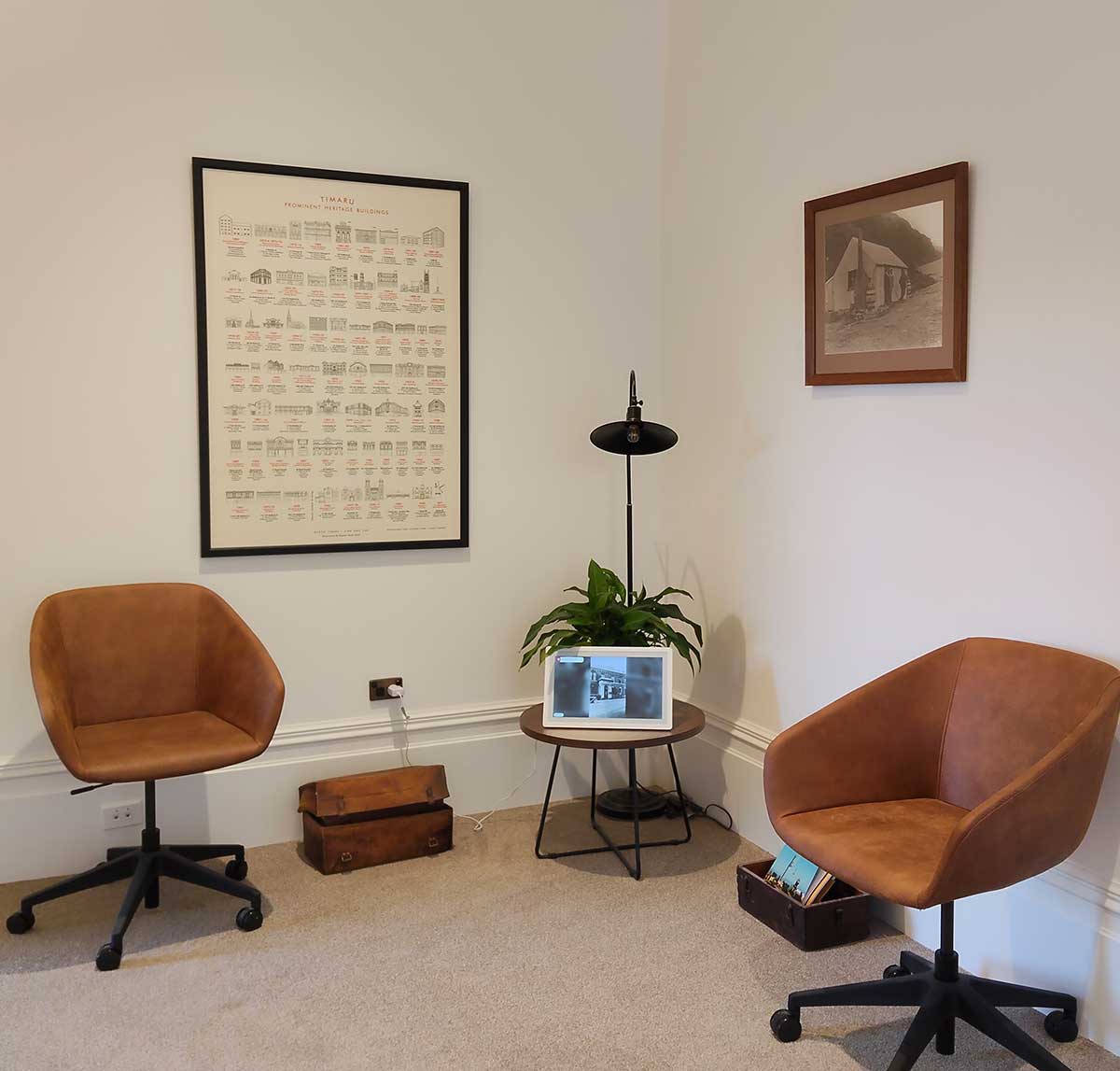
It was very exciting to see my building poster framed annd hanging on the wall in the old bank!
Timeline
- 1837: The Union Bank of Australia issued its first prospectus in London.
- 1840: The bank opened a branch in Wellington, becoming the first bank to operate in New Zealand.
- 1867: The Union Bank of Australia established a branch in Timaru.
- December 1868: A major fire destroyed about 30 buildings (three quarters of the towns wooden central business district) in Timaru’s town centre.
- March 1869: In response to the fire, a council bylaw required masonry construction in Timaru’s central business district.
- 1870: Thomas Roberts emigrated to Canterbury. He had been born and trained as an engineer in England.
- Early 1870s: Roberts worked as engineer to the Timaru and Gladstone Board of Works.
- 1875: Roberts designed the Sealy house, later known as Shand House at Craighead Diocesan School.
- 1876–1877: The new Union Bank of Australia building was constructed at 119 Stafford Street, Timaru.
The building was designed by Thomas Roberts.
The contractor was Thomas Machin.
The building was constructed in Timaru bluestone, also known as basalt, with cement plaster, brick, slate and corrugated iron.
The design followed a Victorian commercial classicism style.
The building was two storeys high, with an irregular rectangular footprint and hipped and gabled roof forms.
Its original use combined banking premises with accommodation for the bank manager and family, reflecting common 19th-century banking practice.
March 1877: The Union Bank of Australia completed its new Stafford Street premises. - 1877: The building contract was valued at about £3000.
Occupation of the building was delayed when contractor Thomas Machin was declared insolvent.
One of Machin’s creditors took possession of the building in place of payment, causing further delay.
Charles Grierson was the Union Bank manager when the new building opened. - Late 19th century: The building contributed to the development of Stafford Street as a key commercial area in Timaru.
Its stone construction showed how Timaru rebuilt more safely after the 1868 fire.
The use of local bluestone connected the building to Timaru’s colonial building tradition.
Turn of the 20th century: The Timaru Union Bank branch was run by a manager and six banking officers. - 1951: The Union Bank of Australia merged with the Bank of Australasia. The new merged bank became ANZ Bank. By 1951: The former Union Bank building had been occupied by the Union Bank of Australia for 74 years.
- 1950s or 1960s: The façade appears to have been extended and remodelled.
- Pre-1970: Modern shop fronts were erected in front of the original building façade.
- Later 20th century: A suspended veranda was installed across the plastered Stafford Street frontage.
In 2018 aheritage assessment:
- By 2018: The building retained exposed bluestone on its south side wall and rear east wall.
The building still had double-hung sash and casement windows.
A single-storey gabled extension stood at the rear, with a hip-roofed brick outbuilding beyond it.
September 2018: Timaru District Council purchased the property to help facilitate development in the area. - 2018 heritage assessment: The building was identified as having historical significance because of its connection with Timaru’s early banking history and the rebuilding of the town centre after the 1868 fire.
- It was recognised as having cultural value because it showed the former way of life of bank managers, their families, staff and customers.
- It was recognised as architecturally significant as the work of early Timaru architect Thomas Roberts.
- It was recognised as technologically significant because of its Timaru bluestone construction.
- It was recognised as contextually important because of its contribution to the historic character of Stafford Street.
- The site was also noted as having potential archaeological value connected to Timaru’s early central business district.
- The building was recorded as District Plan Item HHI71 and given Heritage Category B status.
Source: https://www.timaru.govt.nz/__data/assets/pdf_file/0010/673894/Historic-Heritage-Assessment-Report-HHI71-Former-Union-Bank-of-Australia-Category-B-NEW.pdf
Parent OrganisationUnion Bank of Australia Ltd
The Union Bank Timaru opened on 18 March 1867 in Stafford Street South.
Premises designed by Architect Thomas Roberts, at 119 Stafford Street, were completed in 1877. The building contract was in the region of £3000 and occupation by the bank was delayed slightly when the contractor was declared insolvent and one of his creditors took possession of the building in lieu of payment.
Start Date 18.3.1867- End Date 1951
Key Staff Managers:
1867-1869 ED Byrne
1869-1870 EH Tate
1870-1872 WW Cobb
1872-1874 WR Jeffreys (acting)
1874-1881 CB Grierson
1881-1887 S Hallamore
1887-1891 TY Wardrop
1891-1892 HW Antill
1892-1893 GA McQuarrie
1893-1895 HW Antill
1895-1899 D Stewart
1899-1900 J Gordon (acting)
1900 SJ Gordon
1901-1906 CFM Wroughton
1906-1911 GE Mannering
1911-1913 A White
1913-1918 SJ Gordon
1918-1926 CE Torlesse
1926-1934 W Morrison
1934-1944 WT Irvine
1944-1955 EJ Brock
Successor Organisation Australia and New Zealand Bank Ltd, Timaru Branch
Listed as a heritage building in the Timaru District Plan in 2018 - No. HH171.
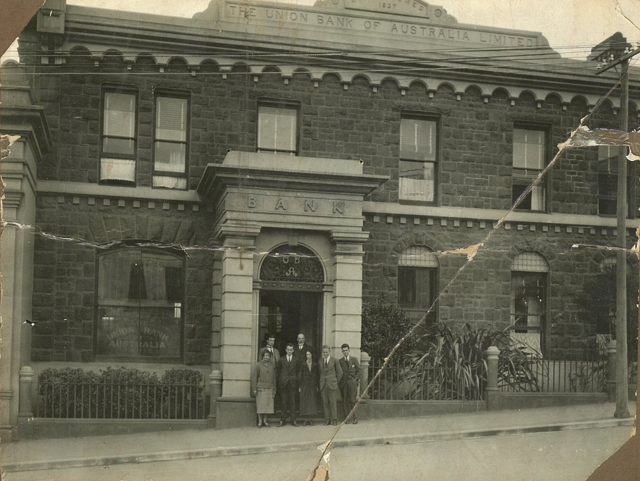
1937 Union Bank of Australia Ltd Timaru Branch - Photo supplied by Timaru District Holdings Ltd
Same but different
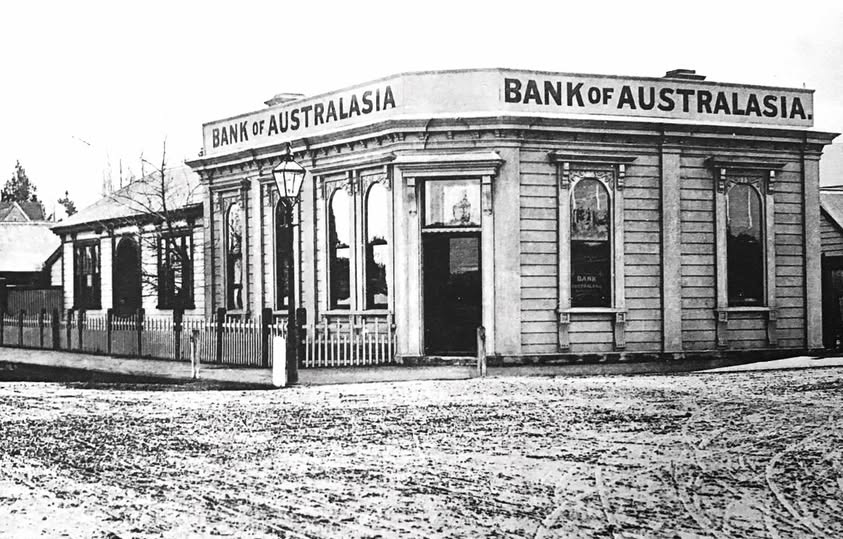
Bank of Australasia in Ashburton, circa 1880, Corner of Tancred & West Street, Ashburton. The building pictured was later on moved to a site in Park Street, next to Dr Billcliffs house. It became St Stephens kindergarten. The St Stephens hall was adjacent to this moved building, they face Burnett Street. On the site of West and Tancred Street was then built a brick building, that building in 2023 houses Federated Farmers. Many thanks Michael Hanrahan Murray Hellewell and Tradewhere - Ashburton Business Directory - 1878 - 1910 by V T Hanson. - Source: https://www.facebook.com/groups/4034626889927412/posts/7059288410794563/

Former Bank of Adelaide then it was now ANZ Bank Building - Photo R Eime 2017.

Corner-Julia-and-Percy-Streets-in-Portland-is-the-ANZ-Bank
ANZ Bank Building, corner of Julia and Percy Streets, Portland, Victoria. Built in grey basalt, the building reflects Portland’s strong tradition of local stone construction, seen in many of the town’s nineteenth-century public and commercial buildings. Portland was permanently settled by Edward Henty in November 1834, following earlier seasonal whaling and sealing activity in the bay. Government land sales began in 1840, and by the 1840s Portland had developed as an important port town with churches, hotels, a school, cemetery, newspaper, jetty, Customs activity and commercial premises. Its civic architecture expanded through the mid nineteenth century, including the Court House, 1845, Customs House, 1850, Anglican Church, 1856, Town Hall, 1865, and Wesleyan Church, 1865. The ANZ Bank Building belongs to this wider streetscape of substantial basalt architecture, expressing Portland’s early prosperity, commercial confidence and role as a regional port.