
By Roselyn Fauth
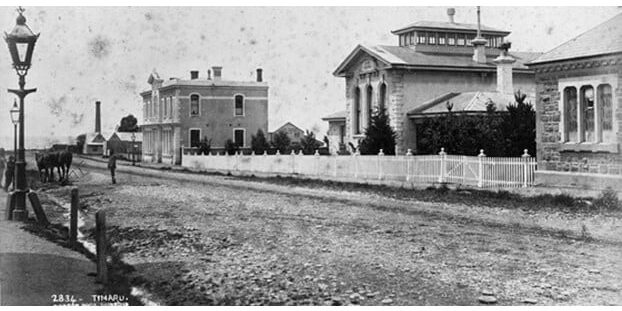
Courthouse, Timaru. Burton Bros. postcard. View of North St. showing from left Mechanics' Institute, Court House and Police Station, taken ca 1880s. Bollinger, Mrs, fl 1958 :Scenic photographs of New Zealand. Ref: PAColl-0808-01. Alexander Turnbull Library, Wellington, New Zealand. /records/23219877 | Alexander Turnbull Library, Wellington
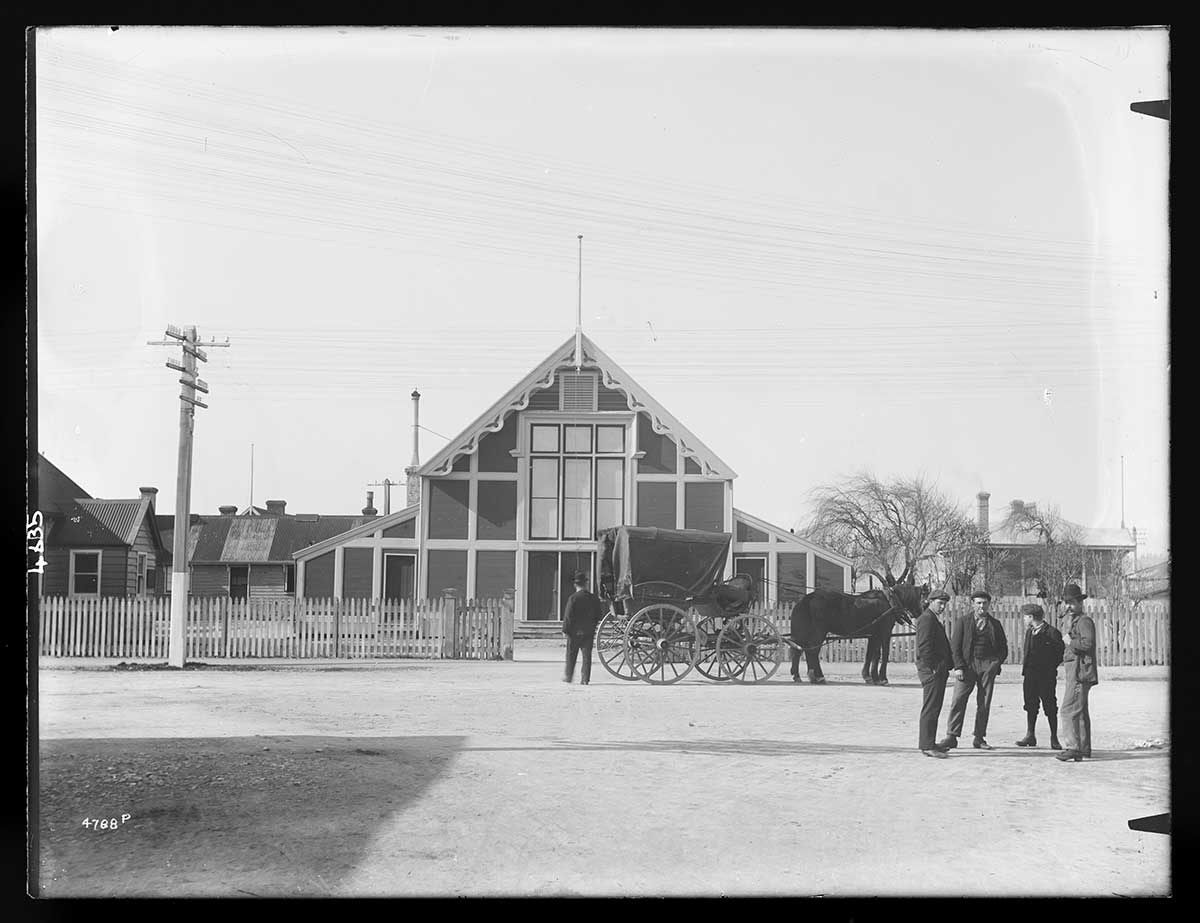
I think some buildings can be easy to misunderstand... or even understimate... this was the lesson I have learned reading about the history of our Timaru Courthouse on North Street. The court building we see today is largely what is has looked like for over a century... A gabled front view with arched windows. When you look closly you can spy the function of the building with its facade lettering. Here the concrete walls bring a formal and just face to the street.
But look again... and instead of just looking at its athestics, you will can see this building can be more than its courthouse function... but a clue. as I have learned on this history hunt, that when you pull one thread from it, half the town's history comes with it: tikanga Māori, British law, Government Town, Rhodes Town, the harbour, customs, police, gaol, railway, public works, Edward Stafford, Julius Vogel, William Henry Clayton, Henry Thornton, the Queen’s Hotel, the Mechanics’ Institute, the Timaru Herald and the question every town eventually has to answer. Yes there are a few threads to follow, and in my brain it looks like an old school detective board... which probably explains why my simple blog about the courthouse has turned into a long blog. But here is my attempt to pull the threads together and share the justice and civic order of Timaru's past together...
Best place I thought we could start is by thinking about how we organise ourselves?
The Timaru Courthouse at 14 North Street was built in 1877 to 1878. It was designed by William Henry Clayton, New Zealand’s first and only official Colonial Architect, and built by contractor Henry Thornton. It opened in a growing port town that needed more than trade and roads. It needed law made local, authority made visible, and justice close enough to reach.
While, a courthouse can make law look as if it begins at the front door... the reality is, we know it does not.
Before British courthouses, police stations and gaols were built in Aotearoa, Māori communities already had systems of law, authority and social order. These varied by iwi and hapū, but were grounded in tikanga Māori, whakapapa, mana, tapu, rāhui, utu, muru, whānau, hapū, iwi, rangatira and kaumātua. I dont have a great knowledge of our Maori past, but I wanted to acknowledge that before the European law and order arrived, there was already a culture with its way of caring and managing people. From what I understand, order was held in relationships, obligations, balance, authority, consequence and restoration.
So when the Law and order from the British courts arrived in Aotearoa, it brought colonisation was a different legal system: English common law, judges, magistrates, police, prisons, written legislation and the authority of the colonial state.
Once I realised this, standing infront of the Timaru Courthouse today reminds me, that we are not looking at the beginning of justice in this place when learning about the arival of the building. We are looking at one chapter in a much longer story: the moment when British colonial justice became visible in North Street.

Courthouse as built. Richardson thesis, unpaginated.
That makes the building more useful, and more complicated.
It asks us: whose law, whose authority, whose rules, and whose stories are made visible in public buildings? British law arrives, and the system starts to separate. The British system brought to New Zealand drew on English common law, magistrates, judges, juries, constables, prisons and public institutions.
After 1840, the colonial government began building those structures here. The Supreme Court was established in 1841. Resident Magistrates’ Courts followed in 1846, bringing more localised justice to a growing colony. District Courts were established in 1858, sitting between the Resident Magistrates’ Courts and the Supreme Court.
Policing also developed in stages. Police Magistrates could appoint selected men to act as police in the 1840s. A constabulary force followed. These were not yet the modern New Zealand Police, but they show the colonial state beginning to organise enforcement, order and criminal justice.
This is where I think the system probably started to divide into parts.
Police investigated and enforced.
Courts heard and decided.
Gaols held people.
Newspapers reported proceedings.
Hotels housed, fed and gathered the people moving through it all.
By the time Timaru’s courthouse was built, that system was becoming visible in streets, buildings and public routines.
Government Town, Rhodes Town and the boundry line of the two towns at North Street.
The courthouse also sits inside an older town-planning puzzle.
Timaru did not begin as one neat plan. It began as two adjoining townships. South of what became North Street was Government Town, laid out on Crown land by Samuel Hewlings after the Canterbury Provincial Government gazetted Timaru as a proposed town site in 1856. North of North Street was Rhodes Town, privately developed on Rhodes land and surveyed by Edwin Henry Lough.
The two plans did not line up neatly. That is why some North Street intersections still feel awkward today. It shows government planning and private enterprise meeting at the edge of town, but not quite shaking hands.
That matters for the courthouse. It stood in the government-planned part of Timaru, close to the boundary with Rhodes Town. North Street was not just a street. It was a civic edge. So the courthouse was not randomly placed. It belonged to the government side of the early town: near land administration, policing, court business and other public functions.
Across and nearby were different kinds of public life: hotels, roads, trade, learning, meetings and newspapers.
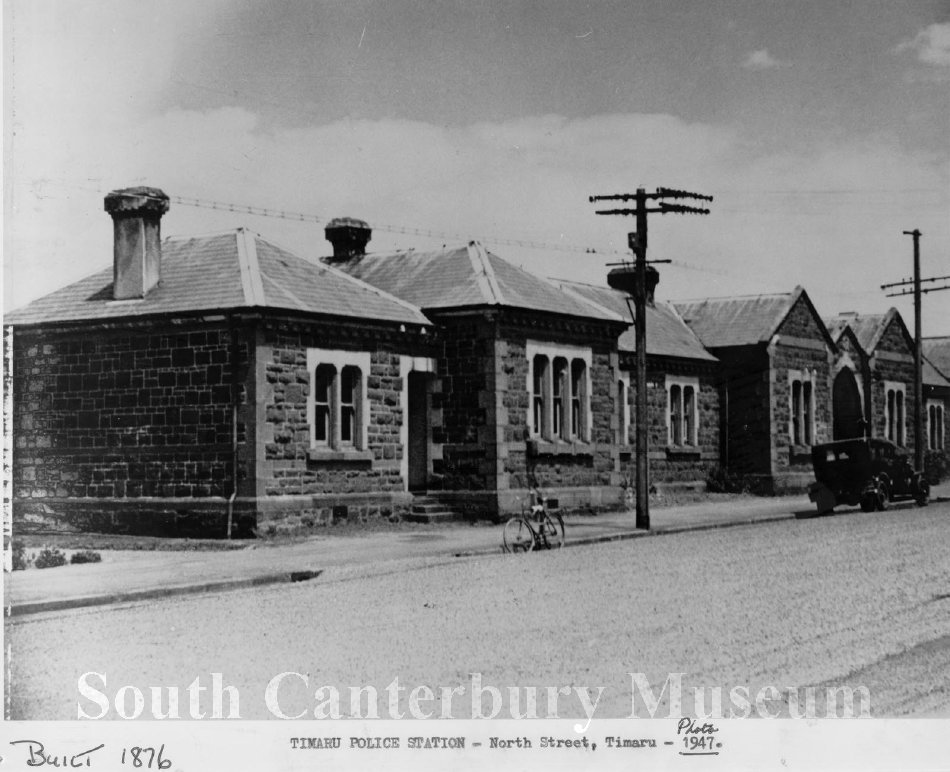
The bluestone Police Station on North Street, Timaru, in 1947. It was built in 1876. Depicts an oblique view of the ingle storey building from across the road, looking south-west. South Canterbury Museum. Catalogue Number 2637
A port needs more than ships
Timaru’s civic buildings also make more sense when we remember the harbour. By the 1850s and 1860s, Timaru was becoming more than a landing place. Wool, stores, shipping, carts, labour, merchants and coastal traffic all needed organisation. Timaru became an official port of entry in 1861, reflecting its growing role in trade.
A port is not just water and ships.
A port needs paperwork, customs, rules, policing, and courts.
A port also needs roads, rail, storage, hotels and government offices.
And ultimately a port needs people who can decide what happens when things go wrong.
Trade creates movement. Movement creates disputes, debts, offences, contracts, accidents and arguments. The more goods and people move, the more a town needs civic structures to support them. So the courthouse belongs to the harbour story too. It was part of the machinery that helped Timaru operate as a growing port town.
The later Custom House, built in 1901 to 1902, is an obvious symbol of government and trade near the harbour. But the need for customs, policing, courts and administration began much earlier. The courthouse is one of the buildings that shows Timaru learning how to manage growth.
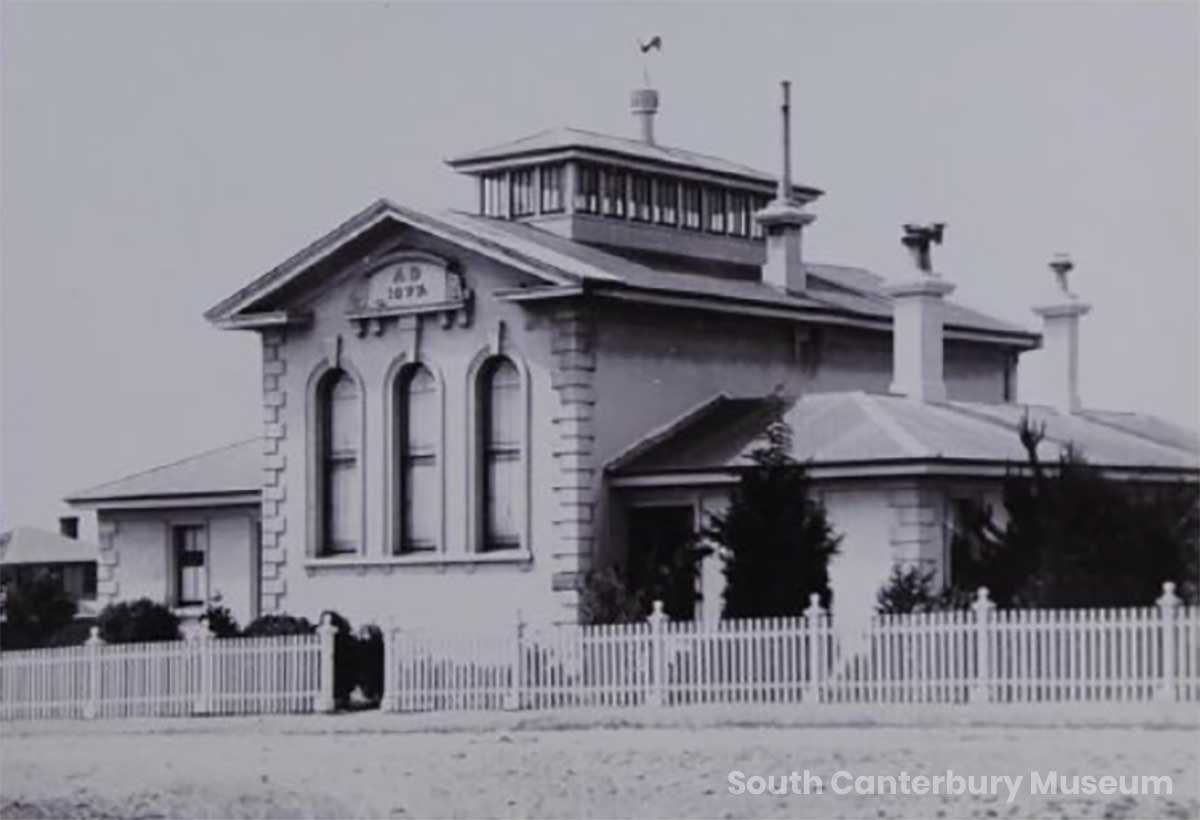
039 The Courthouse on North Street - 1887-1889 South Canterbury Museum 3867
Before the present courthouse
Not every settlement began with a purpose-built courthouse. Often the court business came first and the proper building came later.
Timaru had already used the North Street site for public business before the 1877 to 1878 courthouse was built. An earlier building, dating from 1864, housed the land office and courthouse.
That is important. The site already belonged to Timaru’s justice and administration landscape.
Nearby, the old gaol, built in 1875, formed another part of that law-and-order world. It reminds us that justice was not only hearings and verdicts. It also involved custody, confinement and punishment.
This small area of town carried a big part, if not the whole system.
- Land office.
- Courthouse.
- Police station.
- Gaol.
- Mechanics’ Institute.
- Newspaper.
- Hotel.
They were different buildings, different functions, one civic landscape.
Clayton, Stafford, Vogel and the machinery behind the building
The Timaru Courthouse was designed by William Henry Clayton.
Clayton was born in Tasmania in 1823. He trained as an architect and engineer, studied in Europe, was articled in London, worked in Tasmania, and moved to Dunedin in 1863. In New Zealand, he partnered with William Mason and was involved in major buildings including All Saints’ Church in Dunedin, Dunedin’s former Post Office or Exchange building, and the Colonial Museum in Wellington.
In April 1869, Clayton wrote to Edward Stafford offering his services as Colonial Architect. Stafford was then Premier, Colonial Secretary and Member of Parliament for Timaru. He accepted within days.
The dates are tempting, so I carefully pulled together some history threads to a working timeline.
Clayton’s daughter Mary, known as Polly, had married Julius Vogel in 1867. But Vogel was not yet Colonial Treasurer when Clayton became Colonial Architect, and it would be wrong to say Vogel appointed his father-in-law. The documented appointment came through Stafford. I often hear people say, 'The old Boys club@ and I wondered if reading between the lines this was true? Or maybe, there wasn't that many people around back then to follow through a task, or maybe the relashionships helped get things done. Either way, the sequence is still interesting.
Soon afterwards, Vogel entered central government and became the great driver of New Zealand’s public works and immigration era. That programme expanded the need for roads, railways, bridges, immigration infrastructure and government buildings. Clayton’s role as Colonial Architect became nationally significant inside that expanding machinery.
So this is not scandal, but maybe more of a sequence and government networks.
Stafford who our main street is named after is a interesting thread in this story. When he accepted Clayton’s offer in 1869, he was not only Premier and Colonial Secretary. He was also Timaru’s parliamentary representative. Years later, when the courthouse was tendered, Stafford was no longer Premier, but remained MP for Timaru. The building therefore sits inside a web of local representation, national politics, public works and government architecture.
The timing is the clue... and shows us the courthouse was tendered at a turning point.
Timaru had become a borough in 1868. Trade and port activity were growing. The Timaru to Temuka railway section opened in 1875, strengthening regional movement and connection. Provincial government ended in 1876, shifting more authority towards central government.
So when the courthouse was tendered in 1876 and 1877, it arrived at exactly the moment when local need and national machinery were meeting.
That is the pattern.
- Local growth.
- Port activity.
- Rail progress.
- Public money.
- Central government.
- Justice.
- One concrete building on North Street.
The courthouse was local in use, but national in origin.
Tenders from Wellington
The courthouse was not a borough project.
A Public Works Office notice from the Colonial Architect’s Branch in Wellington called for tenders for the erection of a courthouse at Timaru. A second tender notice appeared in 1877, with drawings and specifications available at the Colonial Architect’s office in Wellington and the Public Works Office in Timaru. Tenders were addressed to the Minister for Public Works and signed by W. H. Clayton, Colonial Architect.
That tells us a lot... especially that the people of Timaru would use the courthouse. They would appear in it, report on it, criticise it and depend on it.
But its design and tender machinery came from central government. That is one of the most useful civic lessons in the whole story: local places often carry national systems. Henry Thornton and the work of making it real. Clayton designed the courthouse, but Henry Thornton had to build it.
Thornton deserves more than a passing mention. He was part of Timaru’s building world at a remarkable moment. He was linked to the Old Bank Hotel on Stafford Street in 1876, the new Town Hall in George Street in 1877, and the Timaru Courthouse in 1877 to 1878.
In just a few years, Thornton helped build places where Timaru drank, stayed, governed, organised fire response and administered justice.
A later auction notice for his estate listed draught horses, drays, harness, timber, scaffolding and contractor’s plant. That gives us a glimpse behind the respectable façade.
Civic buildings were not made by plans alone. They were made through horses, drays, weather, labour, timber, scaffolding, concrete, plaster, roofing iron, credit and risk.
That is built heritage too... not just the architect’s drawing, but the contractor’s world.
Why the building looks like this
The Timaru Courthouse was designed in an Italianate style, part of a government courthouse model Clayton developed for places including Whanganui, Reefton and Timaru.
Look at those courthouses together and a pattern appears: arched openings, formal gables, public lettering and a street-facing confidence that made justice visible in growing colonial towns.
In Timaru, the arched openings with keystones, quoins, double-hung sash windows, gabled form, lettering and formal face to North Street were not just decoration.
They were a message.
This is publicm official, where decisions are made... and where the state has a presence.
The material strengthens the message. The courthouse was built in concrete, plastered cement and corrugated metal roofing. In the 1870s, concrete was still ambitious for government buildings. Clayton was a pioneer in its use, and the Timaru Courthouse is recorded as the only concrete building designed by him that is listed by Heritage New Zealand Pouhere Taonga.
So the building matters twice.
It matters because of what happened inside it.
It matters because of how it was made.
North Street as a civic cluster
The courthouse did not stand alone.
An 1880s view of North Street shows the Mechanics’ Institute, Supreme Court House and Police Station in the same civic cluster. The Mechanics’ Institute mattered because it was associated with public learning, library use, meetings and community improvement.
When the Mechanics’ Institute burned in 1880, newspaper reports described the fire as close enough to scorch or affect the courthouse area. The police station beside the courthouse is modern today, but the relationship is old. A bluestone police station once stood on North Street and was photographed in 1947. The building changed, but the civic relationship remained. Across the road stood the Queen’s Hotel. Nearby was the old gaol. The earlier land office had already formed part of the site’s public history.
This is the point where North Street starts to look less like a street and more like a diagram.
Police investigated and enforced.
Courts heard and decided.
Gaols held people.
Land offices administered Crown business.
Mechanics’ Institutes encouraged learning and improvement.
Newspapers reported proceedings.
Hotels housed and fed people moving through the system.
The street connected them all.
A new courthouse, but not a perfect system
The courthouse was important, but it was not perfect.
When it opened, both the judiciary and the Timaru Herald criticised the adequacy of its interior layout. This is a useful warning against romanticising heritage.
A building can look authoritative from the street and still frustrate the people inside it.
Public buildings have to do more than impress. They have to work.
In June 1878, the Timaru Herald argued for more frequent Supreme Court sittings in Timaru. The paper reminded readers that only two years earlier, the whole of the Supreme Court business for the district had been conducted in Christchurch. Before easier rail travel, that distance was a serious burden.
That is where the abstract word “justice” becomes practical.
I think about justice in logisitics and distance, and costs on peoples time and travel.
There were people a few blocks away, prisoners in gaol waiting for trial.
there were the witnesses being able to appear, not always an easy task.
Justice is families, jurors, lawyers, court staff, police, reporters and the public.
A courthouse brought the law closer to South Canterbury.
But the Herald’s criticism also reminds us that a building alone does not fix a system. You can build the courthouse, but you still need sittings, staff, processes, rooms that work, and decisions about how often justice is available. That is one of the civic lessons that are hidden in plain sight.
What happened inside
The Timaru Courthouse served the Supreme Court, District Court and Resident Magistrate’s Court. Those names tell us something about how a town policed and judged itself. Resident Magistrates’ Courts handled everyday local matters, including minor criminal cases, civil disputes and licensing business. District Courts sat at a middle level. The Supreme Court dealt with more serious criminal and civil cases.
For ordinary people, the courthouse was where law became personal. A person might arrive as a defendant, witness, plaintiff, juror, constable, lawyer, clerk, reporter, judge or worried family member.
Court reports in the Timaru Herald show the routine work of local justice: drunkenness charges, vagrancy, licensing matters, debt claims and serious Supreme Court cases. The court was not only for dramatic trials. It was where everyday public order, money, behaviour and responsibility were argued over.
That makes the courthouse a civic archive in built form. It helps us ask who made laws, who enforced them, who judged, who was brought before the court, who had power, who was vulnerable, who could afford legal help, who waited in custody, who reported the proceedings, and who read about them in the newspaper.
These are not only history questions... they are civics questions... change over time.
The problems identified in 1878 did not disappear. In 1907, a grand jury room was added to help remedy some of the failings. Further additions followed in 1910, the 1950s and 1983. Public buildings have ongoing lives. They are not finished the day they open. The building had to adapt, amd at times, later additions partly obscured the original street frontage. Around 2010 to 2011, modern redevelopment removed front additions, strengthened the building and revealed more of its 1877 to 1878 presence again.
That is another heritage lesson in today's blog. Conservation is not always about returning a building to an imagined perfect past. It is about understanding what has changed, what still matters, and how a public building can continue to serve a living community.
The High Court sat in the building for the last time in April 2009, but the courthouse remains in use by the courts department. Its continued connection with court use adds greatly to its historic value.
It is not simply a former courthouse... It is a building still connected to the system it was built to serve.
Today: the system is still here
Today, New Zealand’s public power is usually described through three branches: Parliament, the Executive and the Judiciary.
Parliament makes laws.
The Executive administers laws and public services.
The Judiciary interprets and applies the law through the courts.
Police are part of the justice system, but they are not the courts. In simple terms, police investigate and enforce. Courts hear and decide.
Timaru is still part of that system. The Ministry of Justice lists Timaru | Te Tihi-o-Maru District Court and High Court at North Street, with services including District Court, High Court, Youth Court, Family Court, Disputes Tribunal, Tenancy Tribunal, Land Valuation Tribunal, jury service and fine-payment services.
The names have changed. The buildings have changed. The systems are more formalised.
But the basic questions remain.
- Who makes laws?
- Who enforces them?
- Who judges disputes?
- How does the public know the system is working?
- How close should justice be to the people it serves?
North Street still carries a living civic function.
What the courthouse teaches us
- The Timaru Courthouse is useful because it turns abstract systems into something visible.
- It shows that government is not only in Wellington. It is also in local buildings.
- It shows that public money, tenders, architects, contractors and departments shape what a town looks like.
- It shows that local needs and national authority meet in public buildings.
- It shows that justice depends not only on laws, but on access, distance, buildings, staff, sittings, transport and public accountability.
- It shows that police, courts and gaols had different roles, but belonged to one wider system of law and order.
- It shows that newspapers helped communities debate whether public services were good enough.
- It shows that architecture can communicate power, order and official purpose.
- It shows that public buildings can be criticised, adapted, hidden, revealed and still remain important.
- And it shows that built heritage can help us see where we have come from, so we can think more carefully about where we are going.
- Good built heritage can teach civics before anyone opens a textbook.
- The courthouse gives that learning a physical address.
Reading North Street today
Next time you walk along North Street, pause at the courthouse.
Look at its arched openings, quoins, gabled front, concrete walls and formal face to the street.
Think about tikanga Māori before British courthouses. Think about British law arriving in Aotearoa. Think about Government Town and Rhodes Town meeting at North Street. Think about Timaru becoming a port of entry, and the need for customs, police, courts, gaols and public administration.
Think about W. H. Clayton in Wellington, Edward Stafford as Premier and Timaru’s MP, Julius Vogel’s public works era, the tender notices sent to the Minister for Public Works, Henry Thornton’s construction work, the prisoners waiting for trial, the criticised courtrooms, the bluestone police station beside it, the Mechanics’ Institute nearby, the old gaol a few blocks away and the former Queen’s Hotel across the road.
This one building helps us read a whole civic landscape... you are not just looking at an old court building.
You are looking at Timaru’s doorway into the machinery of nineteenth-century government.

1950s Mechanics Institute Building forerunner of the Timaru Library in North Street erected in 1880 -Aoraki Heritage Collection Langwoods Photography Timaru, Mechanics Institute Building in North Street (1955?). Aoraki Heritage Collection https://aorakiheritage.recollect.co.nz/nodes/view/41
Mechanics Institute Act: https://www.nzlii.org/nz/legis/hist_act/tmia187741v1877n4411.pdf
https://www.heritage.org.nz/list-details/2050/Courthouse:
Timaru's first court sittings were held in the 1850s in the Custom House building. In 1864 new court offices consisting of seven rooms were built. There were three rooms for the Magistrate's Court, two for Public Works and two for the Survey Department. At the time this build was being constructed it was recognised that the space provided was insufficient and that a larger building was needed to hold the Magistrate's and Supreme Courts. The government was responsible for provision of a plan and William Clayton, Colonial Architect, drew the plans for Timaru. Tenders for a new courthouse were called in 1876 and then again in March 1877.
Before construction began the Timaru Herald (9 March, 1877) commented on the design:
The new courthouse for Timaru will be a striking piece of architecture, and it seems to be well designed for the purposes for which it will be used... Its greatest width will be 75 feet and depth 59 feet. The portion of the building to be used for the Court will be 49 feet long and 25 feet wide, standing end-on to the street, and there will be wings on each side providing the necessary small rooms... In the wings are to be rooms for the judge, the jury, the lawyers, the witnesses, the registrar, and the public; and the fire proof safe is to be situated in one of the wings... The interior of the building will be plastered and a dado will extend along each wall four feet high.. In the front elevation of the Courtroom will be three fine circular headed windows...and the margins of these will be stained glass. The building will be in concrete, with a slate roof, and the ornamentation will be in cement.
The new building was constructed on the site of the former court offices, taking nearly a year to finish and opening on the 4th March 1878. On the building's completion there was considerable criticism of its design and the unsuitability of the internal planning. The height of the judge's seat obscured his view of the jury, the acoustics were defective and the chimneys smoked badly. Efforts to correct these problems were only partly successful but the building continued in its original form until the 1950s when alterations and additions were made. In 1974 when the building had been in use for 96 years it was indicated that it was time for it to be replaced. However, further alterations and additions along the street frontage were made in 1978, securing the building's future for an extended time. Additions to the North Street frontage were made again in 1983 and the building continues its original use today.
Despite the 1978 additions which have altered the Victorian character of the single storeyed street frontage, the building still makes a major contribution to the streetscape. The courthouse section rises above the flanking wings. Notable features are the roof lantern, the gable detailing and the three arched windows featuring keystones and the quoins.

Gardens and Courthouse, Wanganui, circa 1905, Dunedin, by Muir & Moodie. Te Papa (C.012660)
https://collections.tepapa.govt.nz/object/20903?page=1&rtp=1&ros=1&asr=1&assoc=all&mb=c

Courthouse, Cambridge, New Zealand, 1909, Cambridge, by Muir & Moodie. Purchased 1998 with New Zealand Lottery Grants Board funds. Te Papa (PS.001028)
https://collections.tepapa.govt.nz/object/320445?page=1&rtp=1&ros=1&asr=1&assoc=all&mb=c
Courthouse, Hawera, 1905, Hāwera, by Muir & Moodie. Purchased 1998 with New Zealand Lottery Grants Board funds. Te Papa (PS.001228)
https://collections.tepapa.govt.nz/object/320913?page=1&rtp=1&ros=1&asr=1&assoc=all&mb=c
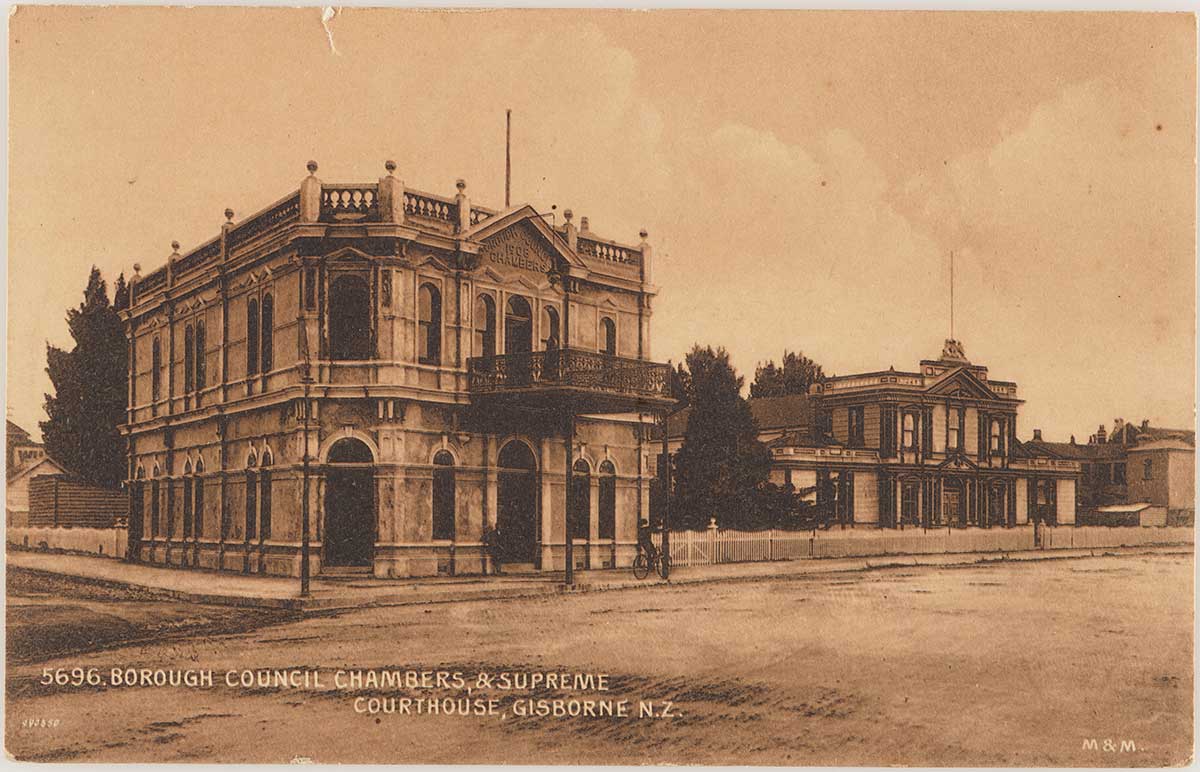
Borough Council Chambers and Supreme Courthouse, Gisborne, New Zealand, 1909, Gisborne, by Muir & Moodie. Purchased 1998 with New Zealand Lottery Grants Board funds. Te Papa (PS.002351)
https://collections.tepapa.govt.nz/object/326684?page=1&rtp=1&ros=1&asr=1&assoc=all&mb=c
Supreme Courthouse, Hokitika, circa 1904, Dunedin, by Muir & Moodie. Te Papa (C.014635)
https://collections.tepapa.govt.nz/object/22883?page=1&rtp=1&ros=1&asr=1&assoc=all&mb=c
Timaru Courthouse, North Street justice precinct and civic-government timeline
Before 1840: law before courthouses
Before British courthouses, police stations and gaols were built in Aotearoa, Māori communities already had systems of law, authority and social order. These systems varied by iwi and hapū and were grounded in tikanga Māori, whakapapa, mana, tapu, rāhui, utu, muru, whānau, hapū and iwi. This is an important starting point because the Timaru Courthouse did not mark the beginning of law in this place. It marked the arrival and visibility of a different legal system: British-derived colonial law.
Sources: S1.
1840 to 1858: British-derived courts and policing develop in New Zealand
After 1840, colonial government institutions began to develop in New Zealand. The Supreme Court was established in 1841. Resident Magistrates’ Courts followed in 1846, giving the colonial state a more localised court structure. District Courts were established in 1858, sitting between Resident Magistrates’ Courts and the Supreme Court. Early policing also developed through police magistrates and constabulary arrangements.
Sources: S2, S3.
1853: Rhodes Town is surveyed
In 1853, the Rhodes brothers’ private township north of present-day North Street was surveyed by E. H. Lough. This became Rhodes Town, the privately developed half of early Timaru.
Sources: S5.
1856: Government Town is planned
In 1856, Government Town was laid out south of North Street on Crown land by government surveyor Samuel Hewlings, after Timaru was gazetted as a proposed town site by the Canterbury Provincial Government. This matters because the courthouse later stood in the government-planned part of early Timaru, not Rhodes Town. North Street became the join between two different approaches to town-making: private enterprise to the north and government planning to the south.
Sources: S5.
1850s: Timaru’s court sittings are held in the Custom House
Timaru’s early court sittings were held in the Custom House building in the 1850s. This is a key fact because it shows court business came before the purpose-built courthouse. In early Timaru, justice was fitted around other government and harbour functions before it had a dedicated building of its own.
Sources: U1.
1857: Belfield Woollcombe becomes Timaru’s first Resident Magistrate
Lieutenant Belfield Woollcombe, a former naval officer, was appointed Timaru’s first Resident Magistrate in 1857, according to the 1978 Timaru Herald retrospective. His appointment links Timaru’s earliest legal administration to a named local figure.
Sources: U1.
1861: Timaru becomes a port of entry
Timaru was appointed or recognised as a port of entry in 1861. Contemporary newspaper material also shows local petitioning for Timaru to be made a port of entry. This is important because a port needed more than ships and cargo. It needed customs, policing, courts, roads, hotels, records, public offices and government administration.
Sources: S6.
1863: William Henry Clayton arrives in Dunedin
William Henry Clayton, who would later design the Timaru Courthouse, arrived in Dunedin in 1863. He had already established himself as an architect in Tasmania and came to New Zealand during the opportunities created by the Otago goldfields.
Sources: S9, U2.
1864: Mason and Clayton partnership
By 1864, Clayton was in partnership with William Mason in Dunedin. The firm became associated with significant buildings, helping establish Clayton’s New Zealand architectural reputation before his later government appointment.
Sources: S9, U2.
1864: Timaru’s first North Street court offices
In 1864, a new building was erected in North Street, next to the Mechanics’ Institute, with three rooms set aside for the Magistrate’s Court. Other rooms were used for public works and survey functions. The later Timaru District Council heritage record also identifies an earlier building on the courthouse site as housing the land office and courthouse. Even at the time, the space was expected to become inadequate quickly.
Sources: U1, S7.
1864: The Timaru Herald begins
The Timaru Herald was founded in 1864. It later became one of the most useful civic sources for the courthouse story, reporting court proceedings, criticising inadequate court facilities and arguing for better access to justice.
Sources: S8.
1867: Clayton’s daughter marries Julius Vogel
In 1867, Clayton’s daughter Mary, known as Polly, married Julius Vogel in Dunedin. This connection is historically interesting, but it must be handled carefully. Vogel did not appoint Clayton as Colonial Architect.
Sources: S9, U2.
1868: Timaru becomes a borough
Timaru became a borough in 1868. This shows the town’s civic status strengthening before the 1877 to 1878 courthouse was built. By this period, Government Town and Rhodes Town were becoming part of one borough, although their street patterns still did not align neatly.
Sources: S5.
1868: Edward Stafford becomes MP for Timaru
Edward Stafford became Member of Parliament for Timaru in 1868. This matters because Stafford was both a major national political figure and Timaru’s parliamentary representative when Clayton became Colonial Architect the following year.
Sources: S9, S10.
5 April 1869: Clayton writes to Edward Stafford
On 5 April 1869, William Henry Clayton wrote to Edward Stafford, then Premier and Colonial Secretary, offering his services as Colonial Architect. Stafford accepted within days. This is the key appointment moment. The documented appointment came through Stafford, not Vogel.
Sources: S9, U2.
April 1869: Clayton becomes Colonial Architect
Clayton became New Zealand’s first and only official Colonial Architect in April 1869. This explains why the Timaru Courthouse was not simply a local commission. It was part of central government’s architectural machinery.
Sources: S9, U2.
12 May 1869: Clayton moves to Wellington
Clayton and his family left Dunedin for Wellington on 12 May 1869. His move placed him at the centre of government architecture.
Sources: U2.
June 1869: Vogel enters central government
Soon after Clayton’s appointment, Stafford’s ministry fell and Julius Vogel entered central government. Vogel later became the great driver of New Zealand’s public works and immigration era. The sequence is important: Vogel was already Clayton’s son-in-law, but he was not yet Colonial Treasurer when Clayton was appointed.
Sources: S9, S10, U2.
1870: Vogel’s public works era begins
In 1870, Julius Vogel’s public works and immigration programme began. It involved large-scale borrowing and investment in roads, railways, immigration and public infrastructure. This era expanded the need for government buildings, including courthouses, customs houses, post offices, police buildings and other public facilities.
Sources: S11, S12.
1870 to 1877: Clayton develops standard government-building plans
During his time as Colonial Architect, Clayton’s office developed standard plans for government buildings across the colony. These plans helped public services become recognisable through architecture. This is important context for the Timaru Courthouse: it was part of a wider pattern of government made visible through buildings.
Sources: S9, U2.
1870 to 1871: Whanganui Courthouse
Clayton’s Italianate courthouse model was realised at Whanganui in 1870 to 1871. This is one of the useful comparison buildings for Timaru.
Sources: S7, S13.
1872: Reefton Courthouse
Clayton’s Italianate courthouse model was realised at Reefton in 1872. Reefton and Whanganui help show that the Timaru Courthouse belonged to a wider government courthouse family, not a one-off design.
Sources: S7, S13.
1873: Clayton moves into the Public Works Department
In 1873, Clayton was transferred to the Public Works Department as head of the architectural division. This matters because the Timaru Courthouse tender notices later came through the Public Works Office and Colonial Architect’s Branch.
Sources: U2.
1874: Clayton’s concrete house
Clayton completed a concrete house for himself in Wellington in 1874. It is no longer extant, but it shows his interest in concrete construction before the Timaru Courthouse.
Sources: S7, U2.
1875: Timaru’s old gaol
The old Timaru gaol was built in 1875, a few blocks from the courthouse. This places the courthouse inside a wider law-and-order landscape of court, police and custody.
Sources: S17.
26 October 1875: Timaru to Temuka railway opens
The Timaru to Temuka railway section opened in 1875. This strengthened Timaru’s regional connections and helped situate the courthouse in a period of rail progress, port growth and expanding public infrastructure.
Sources: S15.
1875 to 1876: Provincial government ends
Parliament decided to abolish provincial governments in 1875, and provincial government came to an end in 1876. This is important because the Timaru Courthouse was tendered during the same period that New Zealand was shifting towards stronger centralised public administration.
Sources: S16.
1876: Government Buildings, Wellington, completed
Clayton’s Government Buildings in Wellington were completed in 1876. This building was one of his major works and shows how government architecture could project authority at a national scale.
Sources: S9, S14.
1876: First tender for Timaru Courthouse
On 26 June 1876, a Public Works Office notice from the Colonial Architect’s Branch called for tenders for the erection of a courthouse at Timaru. This shows the courthouse was organised through central government.
Sources: S18.
1876: Henry Thornton and the Old Bank Hotel
In 1876, Henry Thornton was linked to the construction of the Old Bank Hotel/Tavern on Stafford Street, designed by Daniel West. This helps show Thornton was active in Timaru’s public-facing building work just before the courthouse.
Sources: S19.
23 February 1877: Second tender for Timaru Courthouse
A second tender notice for the Timaru Courthouse was dated 23 February 1877 from the Public Works Office, Colonial Architect’s Branch, Wellington.
Sources: S20.
9 March 1877: Timaru Herald previews courthouse design
Before construction, the Timaru Herald described the proposed courthouse design. The article noted a courtroom standing end-on to the street, with wings for the judge, jury, lawyers, witnesses, registrar and public, and a fireproof safe. This gives us a powerful civic reading: justice was being organised into rooms, roles, records and procedure.
Sources: U1, S7.
12 March 1877: Timaru Herald publishes tender notice
The second tender notice was published in the Timaru Herald on 12 March 1877. Drawings and specifications were available in Wellington and Timaru, and tenders were addressed to the Minister for Public Works. This is core evidence for saying the courthouse was local in use but national in origin.
Sources: S20.
May 1877: Old courthouse demolished
The old courthouse was demolished in May 1877 to make room for the new building, according to the 1978 Timaru Herald retrospective.
Sources: U1.
1877 to 1878: Court business uses borrowed spaces
While the new courthouse was being built, court business was fitted around town. The 1978 Timaru Herald retrospective says courts sat mainly in the old Oddfellows’ Hall in Barnard Street, sometimes in the police barracks, while inquests were often held in nearby hotel lounges. This shows why a purpose-built courthouse mattered. Justice needed proper rooms, not borrowed spaces.
Sources: U1.
24 July 1877: Henry Thornton builds Timaru Town Hall
The Timaru Herald reported on the new Timaru Town Hall in George Street on 24 July 1877 and named Henry Thornton as contractor. This strengthens Thornton’s importance as a builder of Timaru’s civic fabric.
Sources: S21.
23 August 1877: Clayton dies
William Henry Clayton died in Dunedin on 23 August 1877, after an infected old ankle injury led to amputation surgery. He died before the Timaru Courthouse was completed.
Sources: S9, U2.
1877 to 1878: Timaru Courthouse built
The Timaru Courthouse was built in 1877 to 1878 at 14 North Street. It was designed in Italianate style by W. H. Clayton, Colonial Architect, and built by Henry Thornton. It is now Heritage New Zealand List No. 2050, Category 2.
Sources: S7, S22.
1877 to 1878: Materials and form
The courthouse was constructed in concrete and plastered cement, with corrugated metal roofing. The original slate roof was later replaced with metal. The building has a multi-level irregular rectangular footprint, hipped and gabled roof forms, a central courtroom block perpendicular to the street, arch-headed openings with keystones, quoins, sash windows and classical detailing.
Sources: S7.
1877 to 1878: Gable lettering and roof lantern
The gable end was treated as an open-bed pediment with relief lettering bearing the building date and name. The later gable plaque was replaced by current lettering. The central courtroom block originally had a hip-roofed lantern mounted on the ridge; the lantern ventilator and chimneys were later removed.
Sources: S7.
4 March 1878: First sitting in new courthouse
The first sitting in the new courthouse was the District Court before Judge Ward on Monday 4 March 1878.
Sources: U1.
4 March 1878: Immediate criticism from the Timaru Herald
The Timaru Herald criticised the courthouse as soon as it opened. The criticism was not aimed at contractor Henry Thornton’s workmanship, which the paper considered satisfactory, but at the arrangement and design of the court itself. Issues included the judge’s seat making it difficult to see the jury, poor acoustics and smoking chimneys.
Sources: U1, S7.
12 June 1878: Timaru Herald argues for better court access
On 12 June 1878, the Timaru Herald argued for more frequent Supreme Court sittings in Timaru. The paper noted that only two years earlier, Supreme Court business for the district had been conducted in Christchurch. This shows justice was not only about laws and courtrooms; it was also about distance, prisoners, witnesses, time, travel and public accountability.
Sources: S4.
1878: Three courts use the building
The new courthouse served the Supreme Court, District Court and Resident Magistrate’s Court.
Sources: S7.
1 October 1878: Queen’s Hotel opens nearby
The Queen’s Hotel opened nearby in 1878, opposite or close to the justice precinct. This gives the courthouse a wider public-life setting: court, police, hotel, travellers, witnesses, lawyers, publicans and court-day waiting.
Sources: S23.
1878: Harbour works and civic growth
Around this period, Timaru’s harbour works, including the breakwater, were developing. This reinforces the wider context: port, rail, customs, courts, police, hotels and public offices all belonged to Timaru’s growth as a working coastal town.
Sources: S24.
1880: Mechanics’ Institute
The Mechanics’ Institute building in North Street was erected around 1880, according to Aoraki Heritage. The Institute was associated with public learning, library use, meetings and civic improvement.
Sources: S25.
4 November 1880: Mechanics’ Institute fire
The Timaru Herald reported the burning of the Mechanics’ Institute on 4 November 1880. This helps show the physical closeness and interaction of civic buildings in North Street.
Sources: S25.
1880s: North Street civic cluster photographed
An 1880s Burton Brothers photograph shows North Street with the Mechanics’ Institute, Supreme Court House and Police Station together. This is key visual evidence for the courthouse as part of a civic cluster, not an isolated building.
Sources: S26.
1889: Stafford Street renaming
The Great North Road was later renamed Stafford Street in honour of Edward Stafford. This was part of our working research and should be checked against a dedicated street-name or Stafford Street heritage-area source before publication.
Sources: V1.
1901 to 1902: Timaru Customhouse
The former Timaru Customhouse was built near the port and railway in 1901 to 1902. It is later than the courthouse, but it is another important example of government administration, trade and port activity becoming visible in architecture.
Sources: S27.
1907: Grand jury room extended
The grand jury room was extended in 1907 to remedy some of the failings identified in 1878.
Sources: S7.
1910: Further additions
Further additions were made to the courthouse in 1910.
Sources: S7.
1946: Courthouse considered inadequate for replacement
The courthouse was first considered inadequate for replacement as early as 1946, according to the 2004 Timaru Herald article. This shows the building’s inadequacy was not only a nineteenth-century concern.
Sources: U4.
1950s: Additions and courtroom changes
Additions were made in the 1950s. The 1978 Timaru Herald article captions also note that the courtroom had been remodelled in the 1950s and that windows behind the judge’s bench had been altered or blacked out.
Sources: S7, U1.
1970: Replacement raised again
The building’s replacement status was raised again in 1970, with the then Ministry of Works indicating replacement should occur as finances permitted after 1977.
Sources: U4.
1974: Mid-1970s replacement plans do not proceed
Plans to build a new courthouse in the mid-1970s did not come to fruition.
Sources: S7.
1978: Timaru Herald centenary retrospective
In 1978, the Timaru Herald published D. E. Drake’s retrospective, “Timaru Courthouse Thought ‘inadequate’ 100 years ago”. This article connected the 1878 criticisms with ongoing twentieth-century concerns about the building.
Sources: U1.
1981: Deputation to Wellington
In 1981, the Timaru District Council, led by Mayor Ray Bennett, and the Canterbury Law Society took a deputation to Wellington seeking improvements to the courthouse.
Sources: U4.
January 1982: Upgrade announced
In January 1982, an upgrade of the courthouse was announced.
Sources: U4.
1983: Additions
Additions were made around 1983. The 2004 Timaru Herald article says additional offices, interview rooms and a staff room were added after the successful deputation. These additions partially obscured the street frontage and were later removed around 2010 to 2011.
Sources: S7, U4.
Early 1980s: Smaller courts close
Smaller South Canterbury courts, including Fairlie, Temuka and Waimate, closed in the early 1980s. This increased pressure on the Timaru facility, which had to accommodate more staff and members of the public.
Sources: U4.
1985: New two-stage courthouse proposed
In 1985, the Justice Department announced a new two-stage courthouse development for Timaru, with an estimated cost of $5 million. The plan was later mothballed.
Sources: U4.
1992: Structural strengthening
In 1992, strengthening work included new foundations, internal shear walls, ceiling alterations, wall bracing and roof strengthening. The main courtroom became narrower as a result.
Sources: U4.
January 1993: Refurbishments
In January 1993, refurbishments costing $279,984 strengthened the old courthouse structure. That same year, Resident Judge Ian Hay reportedly criticised the courtroom as a “mausoleum” in his farewell address.
Sources: U4.
2004: Court in a time warp
On 21 August 2004, Janine Burgess’s Timaru Herald article “Court in a time warp” documented ongoing concerns about the courthouse. These included prisoner movement through public spaces, inadequate interview rooms, poor soundproofing, jury and witness issues, and security concerns. The article also noted that the main courtroom retained character, including names inscribed by police and reporters on the press bench.
Sources: U4.
April 2009: Last High Court sitting
The High Court sat in the 1877 to 1878 courthouse for the last time in April 2009.
Sources: S7.
Around 2010 to 2011: Redevelopment and strengthening
Around 2010 to 2011, the court precinct was redeveloped. The 1950s and 1983 additions to the street frontage were removed, and the original courthouse was earthquake strengthened and externally refurbished. A new 2000 square metre courtroom complex was built as stage one, followed by renovation and strengthening of the original courthouse. The court remained operating through the project.
Sources: S7, S28.
2011: Architecture awards
The Timaru Courthouse redevelopment by Opus Architecture won recognition in the Canterbury Architecture Awards, including public architecture and sustainable architecture categories.
Sources: S29.
2016: Civic Trust praises adaptive reuse
In 2016, Timaru Civic Trust praised the courthouse redevelopment as a successful adaptive-reuse project. The article argued that good adaptive reuse adds a new layer without erasing earlier ones, and recognised the courthouse redevelopment as a successful integration of old and new.
Sources: U5.
Present day: continued court use
Today, Timaru | Te Tihi-o-Maru District Court and High Court services remain listed at North Street. The building remains in use by the courts department.
Sources: S7, S30.
Present day: civic studies value
The courthouse remains a powerful teaching tool. It helps students and readers understand that government is not only in Wellington. It is also visible in local buildings, tenders, courtrooms, contractors, police relationships, public money, records, repairs and access to justice. The courthouse shows that justice is not only a principle. It is something a town has to house, fund, organise, repair and keep useful for people.
Sources: S30, S31.
Sources and research notes
Core building record: Timaru Courthouse
Timaru District Council. Historic Heritage Assessment Report: HHI55 Timaru Courthouse, Category B.
https://www.timaru.govt.nz/__data/assets/pdf_file/0012/673878/Historic-Heritage-Assessment-Report-HHI55-Timaru-Courthouse-Category-B.pdf
Heritage New Zealand Pouhere Taonga. Courthouse, 14 North Street, Timaru. List No. 2050.
https://www.heritage.org.nz/list-details/2050/Courthouse
Aoraki Heritage Collection. Timaru Courthouse.
https://aorakiheritage.recollect.co.nz/nodes/view/602
WSP. Timaru Courthouse.
https://www.wsp.com/en-nz/projects/timaru-courthouse
Papers Past: Timaru Courthouse tenders, opening and criticism
Papers Past. Timaru Herald, 12 March 1877, tender notice for Courthouse, Timaru.
https://paperspast.natlib.govt.nz/newspapers/THD18770312.2.2.7
Papers Past. Timaru Herald, 12 June 1878, editorial on Supreme Court sittings in Timaru and access to justice.
https://paperspast.natlib.govt.nz/newspapers/THD18780612.2.7
Papers Past. Timaru Herald, 4 March 1878, courthouse opening / early use references.
https://paperspast.natlib.govt.nz/newspapers/THD18780304
Papers Past. Timaru Herald, 24 March 1877.
https://paperspast.natlib.govt.nz/newspapers/THD18770324
Papers Past. Timaru Herald newspaper archive.
https://paperspast.natlib.govt.nz/newspapers/timaru-herald
Tikanga Māori, law and pre-colonial systems of order
Te Ara. Te ture Māori and legislation.
https://teara.govt.nz/en/te-ture-maori-and-legislation
Law Commission. He Poutama, Study Paper 24: Tikanga and Statute Law.
https://www.lawcom.govt.nz/assets/Publications/StudyPapers/NZLC-SP24.pdf
Law Commission. Māori Custom and Values in New Zealand Law, Study Paper 9.
https://www.lawcom.govt.nz/assets/Publications/StudyPapers/NZLC-SP9.pdf
British-derived law, courts and policing in New Zealand
Courts of New Zealand. History of court system.
https://www.courtsofnz.govt.nz/about-the-judiciary/copy-of-overview
Courts of New Zealand. Branches of government.
https://www.courtsofnz.govt.nz/about-the-judiciary/role-of-courts/government
New Zealand Police. The establishment of New Zealand Police.
https://www.police.govt.nz/about-us/history/establishment
Te Ara. Police.
https://teara.govt.nz/en/police/print
Present-day government, civics and courts
New Zealand Parliament. Our system of government.
https://www3.parliament.nz/en/visit-and-learn/how-parliament-works/our-system-of-government/
New Zealand Government. How government works.
https://www.govt.nz/browse/engaging-with-government/government-in-new-zealand/
Ministry of Justice. New Zealand’s constitutional system.
https://www.justice.govt.nz/courts/going-to-court/without-a-lawyer/representing-yourself-civil-high-court/new-zealands-constitutional/
Ministry of Justice. Timaru | Te Tihi-o-Maru District Court.
https://www.justice.govt.nz/contact-us/find-us/timaru-district-court/
Ministry of Justice. Timaru | Te Tihi-o-Maru High Court.
https://www.justice.govt.nz/contact-us/find-us/timaru-high-court/
William Henry Clayton, Edward Stafford and Julius Vogel
Te Ara / Dictionary of New Zealand Biography. Clayton, William Henry.
https://teara.govt.nz/en/biographies/2c20/clayton-william-henry
Te Ara / Dictionary of New Zealand Biography. Stafford, Edward William.
https://teara.govt.nz/en/biographies/1s22/stafford-edward-william
Te Ara / Dictionary of New Zealand Biography. Vogel, Julius.
https://teara.govt.nz/en/biographies/1v4/vogel-julius
New Zealand Parliament. Prime Ministers of New Zealand since 1856.
https://www.parliament.nz/en/visit-and-learn/mps-and-parliaments-1854-onwards/prime-ministers-of-new-zealand-since-1856/
NZ History. The Vogel era: Vogel’s vision.
https://nzhistory.govt.nz/politics/the-vogel-era/vogels-vision
NZ History. Government Buildings, Wellington.
https://nzhistory.govt.nz/media/photo/government-buildings-wellington
National Library of New Zealand. Government Buildings, Wellington, 1876 elevation drawing by W. H. Clayton.
https://natlib.govt.nz/records/22600773
Clayton courthouse comparisons and government architecture
Heritage New Zealand Pouhere Taonga. Courthouse, Reefton. List No. 1685.
https://www.heritage.org.nz/list-details/1685/Listing
National Library of New Zealand. Wanganui / Whanganui Courthouse image records.
https://natlib.govt.nz/records/22637665
Heritage New Zealand Pouhere Taonga. Courthouse, Timaru. List No. 2050.
https://www.heritage.org.nz/list-details/2050/Courthouse
University of Canterbury. Peter Richardson, Building the Dominion: Government Architecture in New Zealand, 1840–1922, PhD thesis.
https://ir.canterbury.ac.nz/
Public works, rail, provincial government and national finance
NZ History. The Vogel era: Vogel’s vision.
https://nzhistory.govt.nz/politics/the-vogel-era/vogels-vision
NZ History. Turning the “first sod” of the Temuka-Timaru railway, 1871.
https://nzhistory.govt.nz/media/photo/first-sod-temuka-timaru-railway-1871
Legislation New Zealand. Immigration and Public Works Act 1870.
https://www.legislation.govt.nz/act/public/1870/77/en/latest/
Te Ara. Colonial and provincial government.
https://teara.govt.nz/en/colonial-and-provincial-government
Te Ara. Economic history: Boom and bust, 1870–1895.
https://teara.govt.nz/en/economic-history/page-5
Timaru, port development and town planning
Te Ara. South Canterbury region: Timaru and its port.
https://teara.govt.nz/en/south-canterbury-region/page-6
Te Ara. Map of the Timaru townships.
https://teara.govt.nz/en/zoomify/19204/map-of-the-timaru-townships
Te Ara. Timaru, 1966 Encyclopaedia entry.
https://teara.govt.nz/en/1966/timaru
DigitalNZ. Timaru port and local history search results.
https://digitalnz.org/records?search%5Btext%5D=Timaru+port+of+entry
North Street civic cluster: Mechanics’ Institute, police station and gaol
National Library of New Zealand. North Street, Timaru, c.1880s Burton Brothers view showing Mechanics’ Institute, Supreme Court House and Police Station.
https://natlib.govt.nz/records/22606354
Aoraki Heritage Collection. Mechanics Institute Building, North Street, Timaru.
https://aorakiheritage.recollect.co.nz/nodes/view/41
Papers Past. Timaru Herald, 4 November 1880, burning of the Mechanics’ Institute.
https://paperspast.natlib.govt.nz/newspapers/THD18801104.2.47
South Canterbury Museum / Timaru District Council PastPerfect. [Police Station, Timaru], bluestone Police Station on North Street, 1947.
https://timdc.pastperfectonline.com/photo/B187E104-1BE2-4AED-9ED1-134175993764
DigitalNZ. [Police Station, Timaru] record.
https://digitalnz.org/records/42281566
Hands On History. Timaru Girls’ time in the old gaol.
https://www.handsonhistory.co.nz/latest-news-blog/archive/2012-03/timaru-girls-time-in-the-old-gaol.17/
Related Timaru heritage buildings
Timaru District Council. Historic Heritage Assessment Report: HHI76 Queen’s Hotel, Category B.
https://www.timaru.govt.nz/__data/assets/pdf_file/0006/673899/Historic-Heritage-Assessment-Report-HHI76-Queen-s-Hotel-Category-B-NEW.pdf
WuHoo Timaru. 1878 Queen’s Hotel, 2 Barnard Street, Timaru.
https://www.wuhootimaru.co.nz/blog/1333-1878-queen-s-hotel-2-barnard-street-timaru
Timaru District Council. Historic Heritage Assessment Report: HHI57 Former Timaru and Gladstone Board of Works Building, Category A.
https://www.timaru.govt.nz/__data/assets/pdf_file/0005/673880/Historic-Heritage-Assessment-Report-HHI57-Former-Timaru-and-Gladstone-Board-of-Works-Building-Category-A.pdf
Heritage New Zealand Pouhere Taonga. Gladstone Board of Works Building (Former). List No. 327.
https://www.heritage.org.nz/list-details/327/Listing
WuHoo Timaru. Former Timaru and Gladstone Board of Works Building.
https://wuhootimaru.co.nz/cbd-heritage-walk/418-gladstone-board-of-works
Timaru District Council. Historic Heritage Assessment Report: HHI48 Old Bank Hotel, Category B.
https://www.timaru.govt.nz/__data/assets/pdf_file/0005/673871/Historic-Heritage-Assessment-Report-HHI48-Old-Bank-Hotel-Category-B.pdf
Heritage New Zealand Pouhere Taonga. Old Bank Tavern, Timaru. List No. 3159.
https://www.heritage.org.nz/list-details/3159/Listing
Timaru District Council. Historic Heritage Assessment Report: Former Customhouse, Timaru.
https://www.timaru.govt.nz/
Historic Places Aotearoa / Blue Plaques. Customhouse, Timaru.
https://historicplacesaotearoa.org.nz/
Henry Thornton, builder / contractor
Timaru District Council. Timaru Courthouse heritage record, naming Henry Thornton as contractor.
https://www.timaru.govt.nz/__data/assets/pdf_file/0012/673878/Historic-Heritage-Assessment-Report-HHI55-Timaru-Courthouse-Category-B.pdf
Timaru District Council. Old Bank Hotel heritage record, naming Daniel West as architect and Henry Thornton as builder.
https://www.timaru.govt.nz/__data/assets/pdf_file/0005/673871/Historic-Heritage-Assessment-Report-HHI48-Old-Bank-Hotel-Category-B.pdf
Papers Past. Timaru Herald, 24 July 1877, opening report for the new Timaru Town Hall, naming Henry Thornton as contractor.
https://paperspast.natlib.govt.nz/newspapers/THD18770724.2.28
Papers Past. Timaru Herald, 9 July 1879, auction notice in the estate of Henry Thornton, contractor.
https://paperspast.natlib.govt.nz/newspapers/THD18790709.2.22.1
Further local research tools
South Canterbury Museum. Research resources.
https://museum.timaru.govt.nz/research
South Canterbury Museum. Online Collections.
https://timdc.pastperfectonline.com/
Aoraki Heritage Collection. Timaru.
https://aorakiheritage.recollect.co.nz/nodes/view/163
Papers Past. Timaru Herald archive.
https://paperspast.natlib.govt.nz/newspapers/timaru-herald
DigitalNZ. Timaru search portal.
https://digitalnz.org/records?search%5Btext%5D=Timaru
BDM Historical Records. Births, Deaths and Marriages Historical Records.
https://www.bdmhistoricalrecords.dia.govt.nz/
Timaru District Council. Cemetery search.
https://www.timaru.govt.nz/community/community-and-culture/cemeteries/cemetery-search
South Canterbury Genealogy Society. Research resources.
https://scgenealogy.nz/resources/r-six/
Archives New Zealand. Family history resources.
https://www.archives.govt.nz/discover-our-stories/family-history-resources
Full source links
S1. Te Ara, “Te ture Māori and legislation”; Law Commission tikanga Māori material
https://teara.govt.nz/en/te-ture-maori-and-legislation
https://www.lawcom.govt.nz/our-work/tikanga-maori
S2. Courts of New Zealand, “History of court system”
https://www.courtsofnz.govt.nz/about-the-judiciary/copy-of-overview
S3. New Zealand Police, “The establishment of New Zealand Police”
https://www.police.govt.nz/about-us/history/establishment
S4. Papers Past, Timaru Herald, 12 June 1878
https://paperspast.natlib.govt.nz/newspapers/THD18780612.2.7
S5. Te Ara, “Map of the Timaru townships”; “Timaru’s two towns”
https://teara.govt.nz/en/zoomify/10791/map-of-the-timaru-townships
https://teara.govt.nz/en/zoomify/11338/timarus-two-towns
S6. New Zealand Gazette index and Papers Past port-of-entry report
https://library.victoria.ac.nz/databases/nzgazettearchive/pubs/gazettes/1861/1861%20Index%20Vol%201.pdf
https://paperspast.natlib.govt.nz/newspapers/NZSCSG18610727.2.10
S7. Timaru District Council, Historic Heritage Item Record Form, Timaru Courthouse, Doc #1304411
https://www.timaru.govt.nz/__data/assets/pdf_file/0012/673878/Historic-Heritage-Assessment-Report-HHI55-Timaru-Courthouse-Category-B.pdf
Also supplied in this chat.
S8. Papers Past, Timaru Herald newspaper archive
https://paperspast.natlib.govt.nz/newspapers/timaru-herald
S9. Te Ara / Dictionary of New Zealand Biography, “Clayton, William Henry”
https://teara.govt.nz/en/biographies/2c20/clayton-william-henry
U2. User-supplied Clayton biography text
Supplied in this chat.
S10. New Zealand Parliament, Prime Ministers of New Zealand since 1856
https://www.parliament.nz/en/visit-and-learn/mps-and-parliaments-1854-onwards/prime-ministers-of-new-zealand-since-1856/
S11. NZ History, “The Vogel era: Vogel’s vision”
https://nzhistory.govt.nz/politics/the-vogel-era/vogels-vision
S12. Immigration and Public Works Act 1870
https://www.legislation.govt.nz/act/public/1870/77/en/latest/
S13. Heritage New Zealand, Reefton Courthouse and Timaru Courthouse
https://www.heritage.org.nz/list-details/1685/Listing
https://www.heritage.org.nz/list-details/2050/Courthouse
S14. NZ History, Government Buildings, Wellington
https://nzhistory.govt.nz/media/photo/government-buildings-wellington
S15. NZ History and Papers Past railway sources
https://nzhistory.govt.nz/media/photo/first-sod-temuka-timaru-railway-1871
https://paperspast.natlib.govt.nz/newspapers/ESD18751027.2.10
S16. Te Ara, “Colonial and provincial government”
https://teara.govt.nz/en/colonial-and-provincial-government
S17. Hands On History, “Timaru Girls’ time in the old gaol”
https://www.handsonhistory.co.nz/latest-news-blog/archive/2012-03/timaru-girls-time-in-the-old-gaol.17/
S18. Papers Past, The Press, 13 July 1876, courthouse tender
https://paperspast.natlib.govt.nz/newspapers/CHP18760713.2.2.3
S19. Heritage New Zealand, Old Bank Tavern; Timaru District Council Old Bank Hotel record
https://www.heritage.org.nz/list-details/3159/Listing
https://www.timaru.govt.nz/__data/assets/pdf_file/0005/673871/Historic-Heritage-Assessment-Report-HHI48-Old-Bank-Hotel-Category-B.pdf
S20. Papers Past, Timaru Herald, 12 March 1877, courthouse tender notice
https://paperspast.natlib.govt.nz/newspapers/THD18770312.2.2.7
S21. Papers Past, Timaru Herald, 24 July 1877, new Timaru Town Hall
https://paperspast.natlib.govt.nz/newspapers/THD18770724.2.28
S22. Heritage New Zealand, Timaru Courthouse
https://www.heritage.org.nz/list-details/2050/Courthouse
S23. Timaru District Council Queen’s Hotel record; WuHoo Timaru Queen’s Hotel page
https://www.timaru.govt.nz/__data/assets/pdf_file/0006/673899/Historic-Heritage-Assessment-Report-HHI76-Queen-s-Hotel-Category-B-NEW.pdf
https://www.wuhootimaru.co.nz/blog/1333-1878-queen-s-hotel-2-barnard-street-timaru
S24. Te Ara South Canterbury region; CPlay Timaru Port story
https://teara.govt.nz/en/south-canterbury-region/page-6
https://www.cplay.co.nz/stories/detailed-stories-to-share/28-timaru-port
S25. Aoraki Heritage Mechanics Institute; Papers Past Mechanics Institute fire
https://aorakiheritage.recollect.co.nz/nodes/view/41
https://paperspast.natlib.govt.nz/newspapers/THD18801104.2.47
S26. National Library, North Street, Timaru, Burton Brothers, ca 1880s
https://natlib.govt.nz/records/22606354
S27. Timaru Customhouse sources
https://www.heritage.org.nz/list-details/324/Listing
https://natlib.govt.nz/records/22314180
S28. C. Lund and WSP, Timaru Courthouse redevelopment
https://c-lund.co.nz/projects/timaru-courthouse.html
https://www.wsp.com/en-nz/projects/timaru-courthouse
S29. NZIA / Architecture Now, 2011 Canterbury Architecture Awards
https://www.nzia.co.nz/awards/local-architecture-awards/timaru-courthouse-redevelopment/4303/
https://cdn.architecturenow.co.nz/articles/twelve-projects-honoured-in-canterbury-architecture-awards/
S30. Ministry of Justice, Timaru District Court and High Court
https://www.justice.govt.nz/contact-us/find-us/timaru-district-court/
https://www.justice.govt.nz/contact-us/find-us/timaru-high-court/
S31. New Zealand Parliament and Courts of New Zealand, branches of government
https://www3.parliament.nz/en/visit-and-learn/how-parliament-works/our-system-of-government/
https://www.courtsofnz.govt.nz/about-the-judiciary/role-of-courts/government
S32. Papers Past, Timaru Herald, 9 July 1879, Henry Thornton estate auction notice
https://paperspast.natlib.govt.nz/newspapers/THD18790709.2.22.1
U1. User-supplied 1978 Timaru Herald article images, D. E. Drake, “Timaru Courthouse Thought ‘inadequate’ 100 years ago”
Supplied in this chat as images. Research access:
https://aorakiheritage.recollect.co.nz/pages/newspaper-holdin
U4. User-supplied 2004 Timaru Herald article, Janine Burgess, “Court in a time warp”, 21 August 2004
Supplied in this chat.
U5. User-supplied 2016 Timaru Civic Trust column by Karen Rolleston
Supplied in this chat. Suggested access through Timaru Civic Trust records, Timaru Herald archive, or Aoraki Heritage newspaper holdings.
V1. Stafford Street renaming, September 1889
Working research note only. Check against Timaru District Council Stafford Street Historic Heritage Area assessment or a local street-name source before publication.