
By Roselyn Fauth
I was on a hunt for William Williams in 2025, and after a Summer holiday there, and a trip to Brunner, I wanted to revisit my research on Kumara now with wider eyes. Wiiliam is noted in the history books as the first recorded birth of a European baby in Timaru, 1865 at the foot of George Street next door to where the Timaru Landing Service Building is today. Like so many young men of his generation, he was swept up into something much bigger. Because at just twenty years old, William arrived in Kumara on the hunt for gold.
And that is how Kumara entered my story.
I drive through it fairly often, usually on the way to see family on the West Coast. I really like Kumara. The restored buildings link back to the boom years, the heritage signage is excellent, and you can walk out to Londonderry Rock, and finish at the rennovated historic pub for a beer… (the best loaded fries I have ever had by the way).
Last year with our family and my in-laws we went to Kumara to look for history about William. In in that gold rush landscape, I imagined his footsteps there, folded into the terraces, the claims, and even the road names, like Larrikins Road.
I’d already shared in another blog that the name has a special connection, but curiosity has a way of multiplying. One question became five, and I found myself reaching out to the Hokitika Museum.
They kindly sent me a small but fascinating booklet published by the West Coast Historical Museum in 1998: Larrikins’ Lode: Episodes in the History of the Kumara Gold Rush. with a bit of time on my hands while the family watched cricket... I read back through the booklet and thought you might enjoy reading what I learned.
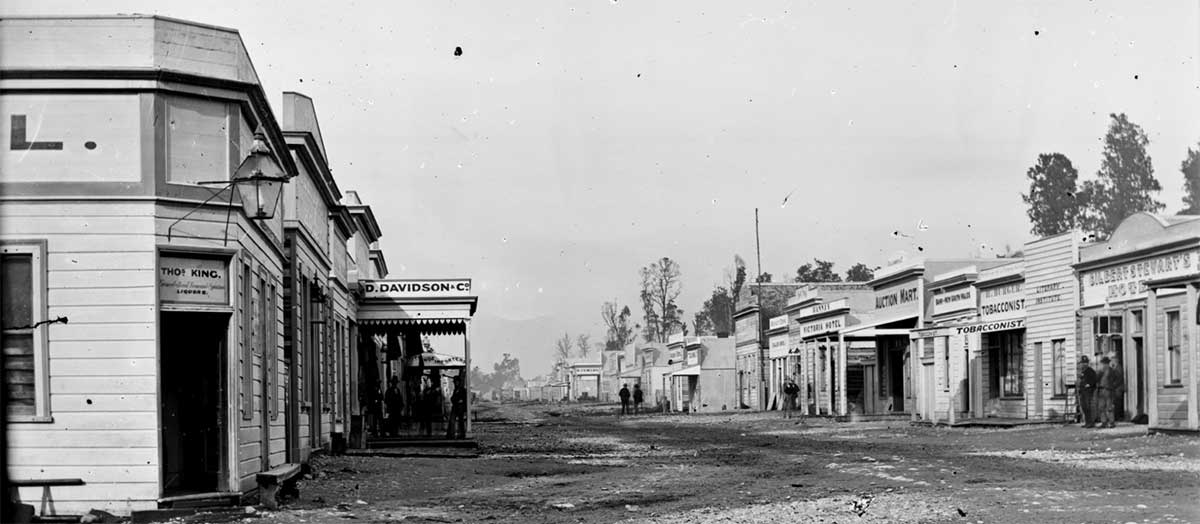
Kumara, Seddon St, by Burton Brothers. Te Papa (C.025230)
What the booklet taught me first is that Kumara’s gold wasn’t sitting conveniently in a riverbed waiting for someone with a pan. If you wanted its potential fortune you had to work hard for it.
The deposits lay deep in the bottom layers of gravel, shaped by ancient glacier action. The Taramakau Glacier had left gold at different levels, forming terraces and what miners called “false bottoms”. These gravels were mixed with huge boulders, making the ground heavy under the forests, stubborn, and difficult to work.
When gold was discovered in mid 1876 near the secret claim of Cashman, Houlihan and Party, word spread fast. Within no time, around 6000 people had gathered to investigate and peg claims. People realised Kumara could mean greater wealth than other fields, and the rush surged into life almost overnight.
Gold lay deep underground. Tunnels had to be driven fifty to one hundred feet down, with heavy timbering just to stop the earth collapsing in. Later, hydraulic sluicing became common, but the problem of tailings never really went away.
Boomtown Energy (and Forty Seven Hotels)
By January 1878, Kumara was booming. The booklet describes a town forming almost instantly: merchants, bakers, butchers, blacksmiths, storekeepers, publicans… all rushing in alongside the miners. By that point there were 47 seven day hotels operating across the field. Four in Dillmanstown, two at Larrikins, and the rest in Kumara itself.
That is an extraordinary number of hotels for one goldfield! You can almost hear the noise. Imagine if 6000 people suddenly flocked to Timaru...
And yet, alongside all that chaos, permanence arrived quickly too. The first state school opened in February 1877 with eighty pupils in one building. A hospital followed in 1878 because accidents were so frequent, first as a tiny receiving hut with two stretchers, then as a proper building funded through subscriptions and government support.
Kumara grew quick from being just a camp to becoming a town.
Water, Engineering, and Sludge Channels
Another thing I hadn’t fully understood until reading this is that Kumara’s story is also a water story. Hydraulic sluicing required enormous volumes of water. Water races and flumes were built to bring supply to the claims, washing gravel down sluice channels so the gold could settle into boxes.
Holmes’ Water Race Company began supplying water in 1878, providing thirteen heads of water for eight hours a day. Eventually the Government took over and expanded the system. In 1879 the Government owned Waimea Kumara Water Race opened, growing into a huge network of tunnels, flumes, syphons and ditches stretching twenty one kilometres.
And then came the tailings problem...
By 1882, underground sludge channels were being built to flush tailings into the Taramakau River. One channel was washed regularly with twenty heads of water, and a second was later subsidised at a cost of two thousand pounds. Standing in Kumara today, with its calm heritage frontage, it is hard to imagine the scale of what was carved into the landscape.
So Who Were the Larrikins?
And then we come back to the name that started this whole side quest... The booklet explains that seven leads spread out from Dillmanstown: Shilling Lead, Scandinavian Lead, Ross Terrace… and Larrikins Lead.
But the name “Larrikins” wasn’t romantic. It was trouble... The claim was named after a party of young men during the first rush who broke windows, committed robberies, and caused enough chaos that they became known locally as “the larrikins”, even questioning the township policeman, the “Man in Blue”.
The exact discovery date of Larrikins Lead is recorded as 25 February 1888.
And it was worked by three men described simply as “the larrikins”:
Frank Payne
Sam Deans
Billy Williams
There he is.
Timaru’s first European baby, now grown into a West Coast miner, literally named into the landscape.
A Rock from the Roadside
My father in law, Paul, was the one who really helped it click into place. He showed me around properly, as someone trying to read the land. At one point he stopped the car and pointed out a pile of tailings left behind from the mining days on Larrakins Road. I’d driven past things like that a hundred times without really understanding what I was looking at.
Paul explained how the earth had been shifted, washed, worked over, and then left behind. The discarded gravel of somebody’s hope.
We picked up a rock from the side of the road and brought it back to Timaru. Just an ordinary piece of the West Coast, but to me it felt like a fragment of William’s world. Something he would have seen under his boots when he arrived chasing gold. That rock is now part of a monument for his mother, Ann Williams.
Ann never saw Kumara. She never saw her son grow into adulthood. She died so early in Timaru’s story, when William was four and his sister Rebecca was six in 1860, that her grave remains unmarked.
But this small piece of landscape, carried home, feels like a quiet way of linking them again: mother and son, Timaru and the Coast, beginnings and goldfields.
What This Taught Me
What this little booklet taught me most of all is how layered Kumara really is.
On the surface, it’s a beautiful heritage town with restored buildings, good stories on the signboards, and an easy sense of charm. But underneath that calm streetscape is an extraordinary landscape of terraces, tunnels, water races, sludge channels, ambition, danger, ingenuity, and a rush of thousands of people chasing something that might change their lives.
It also reminded me how strongly our histories are still told through the men.
Larrikins’ Lode is rich with detail about the miners, the claims, the engineering, the hotel boom, and the characters who left their names on the map, including Billy Williams himself. And I’m grateful for that, because it helped me place him properly in the Kumara story.
But as I read, I couldn’t help noticing the familiar gap... There is plenty here about the larrikins, the prospectors, the parties of men and the work they did… but far less about the women who were also living in this sudden town, raising children, nursing the injured, running households, holding communities together, and watching the gold rush unfold around them.
So this feels like another beginning...The booklet gave me the bones of the story, and a road name that now means something real. But if I want to understand Kumara fully, I’ll have to keep hunting… this time for the women’s stories still waiting in the margins.
History, as always, is never finished. It just invites us further in.