
By Roselyn Fauth
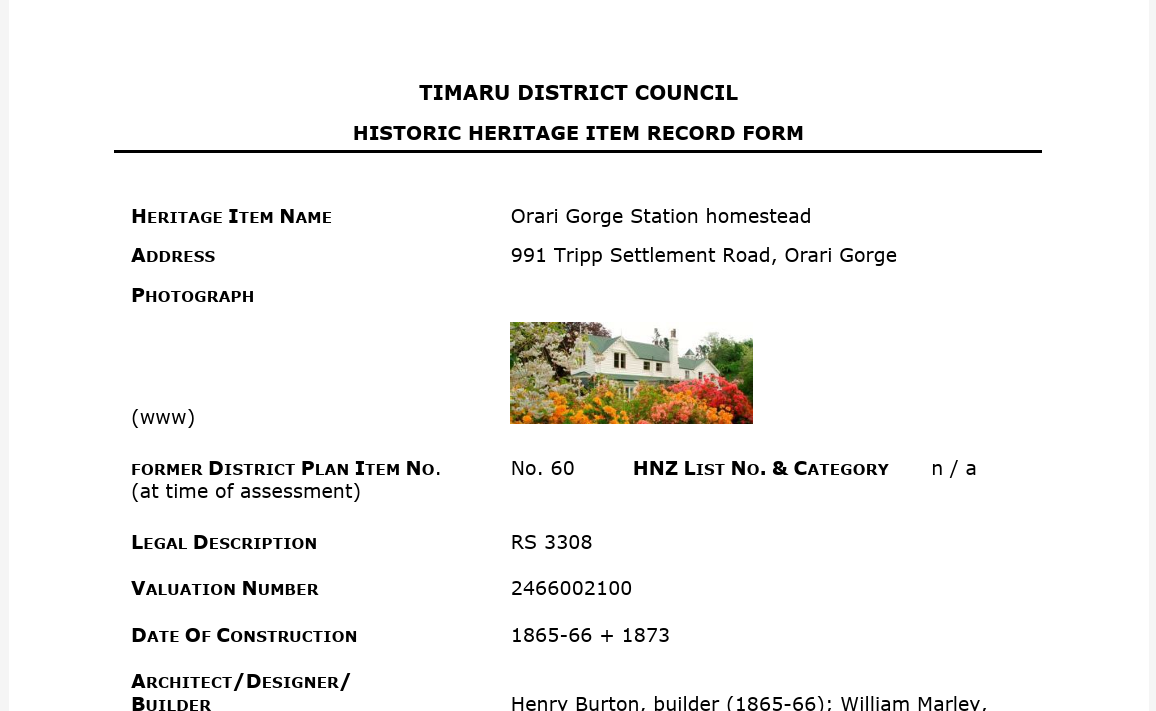
Screen shot of the Timaru District Councils Heritage Report on Orari Gorge Station homestead, 991 Tripp Settlement Road, Orari Gorge. Built by Henry Burton (1865-66); and designed by architect William Marley (1873) in Domestic Gothic Revival. Two-storey dwelling with irregular rectangular footprint and gabled roof forms. Principal elevation faces east. Ogee shaped gabled dormers above veranda, flanked by faceted bay window on east elevation. Scalloped bargeboards, latticed veranda posts, finials. Double hung sash windows. Charles George Tripp (1826-97) emigrated to New Zealand from England in early 1855 and within the year had taken up the Mount Peel, Mt Possession, Mt Somers and Orari Gorge runs. Initially in partnership with JBA Acland, Tripp, who had trained as a lawyer, retained the Orari Gorge station when the partnership was dissolved in 1862. He had married Ellen Harper, a daughter of Bishop Harper, in 1858 and the couple had eight children.
I was looking for people. For family threads. For women’s names lined to a memorial library named in honour of Eleanor Tripp in Woodbury. Among my winding path of side quests that began with the Tripp family, I came across a heritage report published by the Timaru District Council. These heritage reports are gold. Not only do they have some much excellent information, I know I can trust was has been recorded which saves me a lot of work and gives me confidence to plow on history hunting with more breadcrumbs from the reports. With this building file in front of me, my question shifted from wondering who the Tripp's were, to wondering where they lived.
A small thumbnail on the page gave me a glimpse of the historic home. A two-storey timber house with an irregular footprint and gabled roof forms, its principal elevation facing east. Ogee-shaped dormer windows above a verandah, flanked by a faceted bay window. Scalloped bargeboards, finials and latticed verandah posts. Double-hung sash windows.
Orari Gorge Station homestead sits well back from Tripp Settlement Road, you can reach it by a long drive that follows the western bank of the Orari River. You don’t stumble across this home, you have to mean to go there...
The house was built for Charles George Tripp and his wife Ellen Harper, whom he married in 1858. I have written about Ellen in a previous blog based on a book she wrote about her life.
Charles emigrated from England in early 1855 and, within a year, had taken up some of Canterbury’s earliest and most significant sheep runs alongside his partner John Acland. Together they did something no other pastoral lessees had yet attempted, taking up high country land beyond the formal boundaries of the Canterbury settlement. It was a pioneering move, and one that helped shape the future of pastoralism in the region.
When the partnership dissolved in 1862, Acland retained Mount Peel, while Tripp’s allotment included Orari Gorge Station and Mount Somers. By the time the homestead was built in 1865–66, Orari Gorge was already a working station. The first buildings on the property had been constructed in 1859–60 by Robert Smith, the partnership’s head man.
These included a slab cottage to live in and a whata, a raised store building that blended Māori and English building traditions. Other working structures followed under station manager William Hudson, including a blacksmith’s shop, saddlery, coach house and stables.
Work came first. Domestic life followed.
The earliest part of the homestead was built by Henry Burton. At that stage, Charles and Ellen were still living elsewhere, moving between Mount Peel and Mount Somers and making an extended visit back to England. They finally took up residence at Orari Gorge in September 1866 and this was the house they returned to. The place where eight children would be raised. Where seasons, routines, losses and celebrations would fill the rooms.
In 1873 the homestead was enlarged, with additions attributed to Canterbury architect William Marley. If we were to visit the house today, we would see it reflecting a time of expansion and confidence. Designed in the Domestic Gothic Revival style popular in the 1860s and 1870s, it balances its looks with rural practicality. Timber framing and cladding sit on a stone foundation, with brick elements and corrugated iron roofing.
At its fullest extent, the Orari Gorge Station was huge. The property used to stretch from the Orari River to the Hae Hae Te Moana River, encompassing more than 20,000 acres of freehold land and around 50,000 acres of leasehold. More than 40,000 sheep grazed the station. It was a substantial part of Canterbury’s early pastoral story. Yet despite the scale of the enterprise, the homestead remained a domestic place first.
After Charles Tripp’s death in 1897, the station passed to his son Bernard Tripp.
In 1910 the government resumed much of the leasehold land and purchased some of the freehold for small farm settlement, reshaping the run forever. The landscape changed. The scale reduced. Still, the homestead remained and would have felt like to many an anchor point in the area.
According to the heritage report, the Orari Gorge Station was still in the Tripp family ownership at the time the report was written, carrying nearly 170 years of continuity and family history the landscape.
The house does not stand alone, and a search on the Heritage New Zealand website explains it has a historic woolshed and early farm buildings nearby. These are also recognised as one of the most complete surviving station complexes of their type in New Zealand. Together they tell a fuller story of life at Orari Gorge. Of how labour shaped their home and land. Of how Māori and European building traditions intersected.
So what is the homestead like now?
The Gothic detailing of their home is softened by trees, gardens and time. Its amazing to think that at one point someone had planted these as little seeds or baby plants. I wondered if they envisioned the home being surrounded decades later when the trees were fully grown. This is a house that has been lived in, altered thoughtfully, and cared for rather than frozen. A private home, which thankfully has a heritage report online so I can be nosey.
I began this hunt wanting to understand the Tripp family better. As I am learning more, I think about how houses carry memory, even when we only meet them through reports, photographs and bits and pieces that we can find online. Places like Orari Gorge Station homestead remind us that heritage is not only about age or architecture, but about people who stayed, adapted, and kept returning to the same ground, generation after generation.
Side Quest: The Eleanor Howard Tripp Memorial Library
While tracing the Tripp family through Orari Gorge Station, another place kept appearing in the background: the Eleanor Howard Tripp Memorial Library at Woodbury.
Eleanor Howard Tripp was one of the daughters of Charles George Tripp and Ellen Harper, the same couple who built and lived at the Orari Gorge Station homestead. She grew up within the world shaped by the station, family, and work.
After Eleanor’s early death, a memorial library was built in her name at Woodbury in 1936. Unlike the homestead, which remained a private family home, the library became a public building, carrying the Tripp family story beyond the station gates and into the wider community.
The heritage report for Orari Gorge Station homestead notes this relationship as part of the site’s contextual significance. Together, the homestead and the library show two sides of the same story: the private domestic life of an early settler family and the way that life was later remembered and commemorated publicly. Now I see that Orari Gorge Station is not an isolated historic place. It sits within a network of buildings, landscapes and memorials that trace how one family’s story became woven into the social and civic fabric of South Canterbury.
Side Quest: Orari Gorge Station Today
After reading the heritage reports, I looked to the present and found the Orari Gorge Station website. The station continues as a working high-country farm in the South Canterbury foothills, just north of Geraldine.
Orari Gorge Station has remained in the same family for nearly 170 years. Today, the fourth, fifth and sixth generations live on the property. It is currently run by Robert Peacock, a fifth-generation descendant. His mother, Rosa Peacock, was the daughter of Charlie Tripp, grandson of Charles George Tripp, who first settled Orari Gorge in the 1850s.
The property spans river flats at around 750 feet above sea level, rolling clay downs between 1,000 and 1,500 feet, and tussock country rising to approximately 3,500 feet. The station winters around 25,000 stock units, including 9,000 breeding ewes, 700 registered Hereford cows, and 2,000 English Red hinds.
If you’re a townie like me, and you see that Orari Gorge Station sells bulls, you might wonder what that actually means. In simple terms, the station makes its money by breeding livestock and selling genetics, so its a lot more than just raising animals for their meat.
They breed registered Hereford cattle and operate three sheep studs: Romney Maternal, RomTex Maternal and SufTex Terminal, with around 1,200 fully recorded ewes going to the ram each year. The bulls they sell are breeding bulls, purchased by other farmers to improve the productivity, resilience and performance of their own herds.
The station also raises and finishes large numbers of sheep, cattle and deer for meat production. Most progeny are finished on the farm and sold through standard agricultural markets. Some stock are sold store, meaning they are sold on to other farms to be finished elsewhere, and these are described as being in strong demand.
Since 2019, Orari Gorge Station has also hosted the Beef + Lamb New Zealand Low Input Progeny Test. This involves the artificial insemination of commercial ewes to leading industry sires, with every aspect of progeny performance measured under low-input farming conditions.
Land stewardship is a strong focus. Creeks are fenced from stock, drinking water for the homesteads is drawn directly from the creek, and more than 700 hectares of native bush are retained on the property, over 500 hectares of which are fenced. Between 2018 and 2021, 160 hectares were protected under a QEII Trust covenant. In 2012, the family received the QEII Trust Inter-Generational Award for stewardship of the land.
Orari Gorge Station remains a fully operational farming enterprise, with its annual bull sale marking the continuation of a long-standing working tradition rather than a preserved historic site.
Sources
https://www.heritage.org.nz/list-details/7763/Listing
https://www.timaru.govt.nz/__data/assets/pdf_file/0004/673987/Historic-Heritage-Assessment-Report-HHI166-Orari-Gorge-Homestead-Category-B.pdf