
TIMARU
Ashbury Park
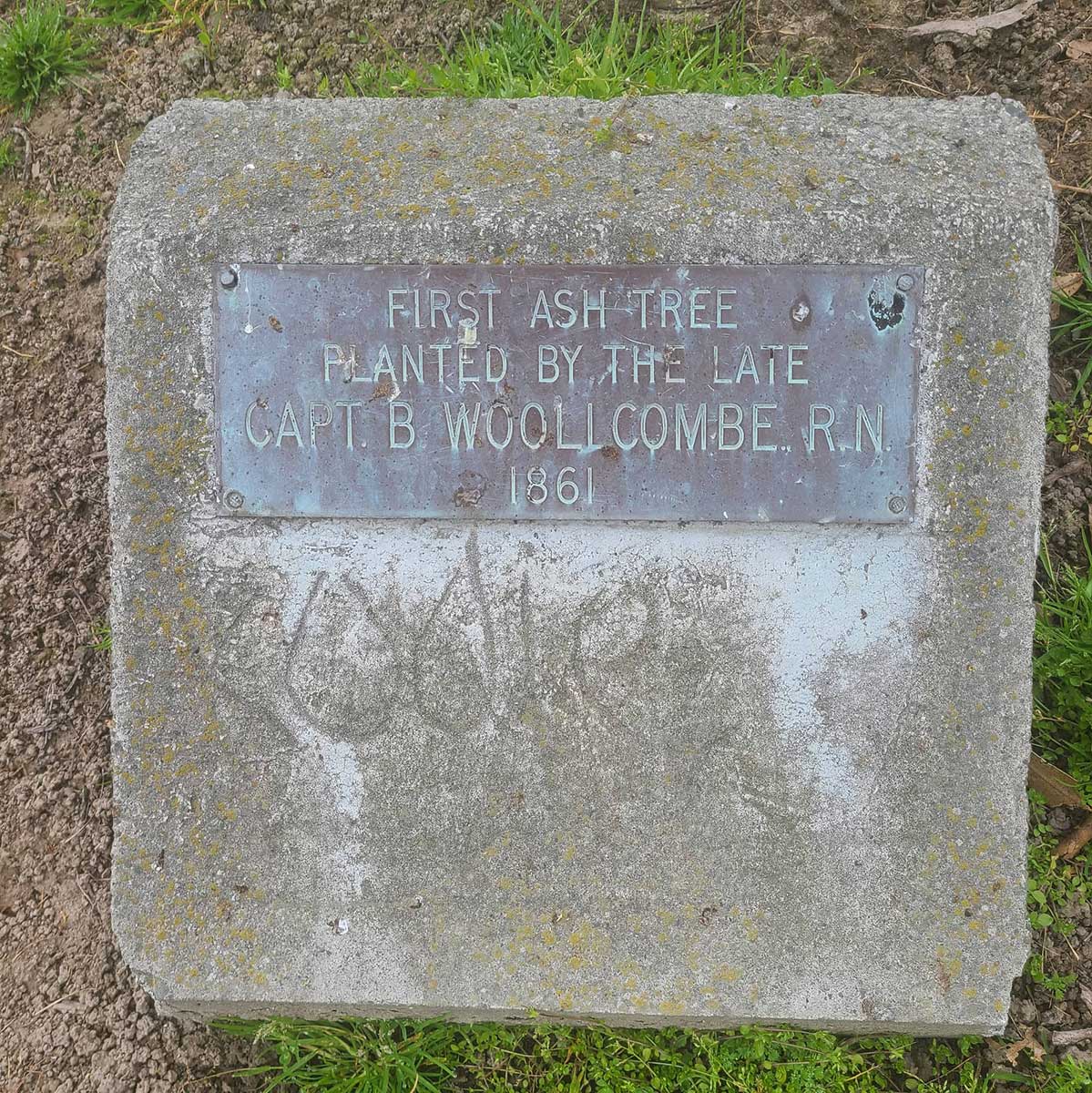
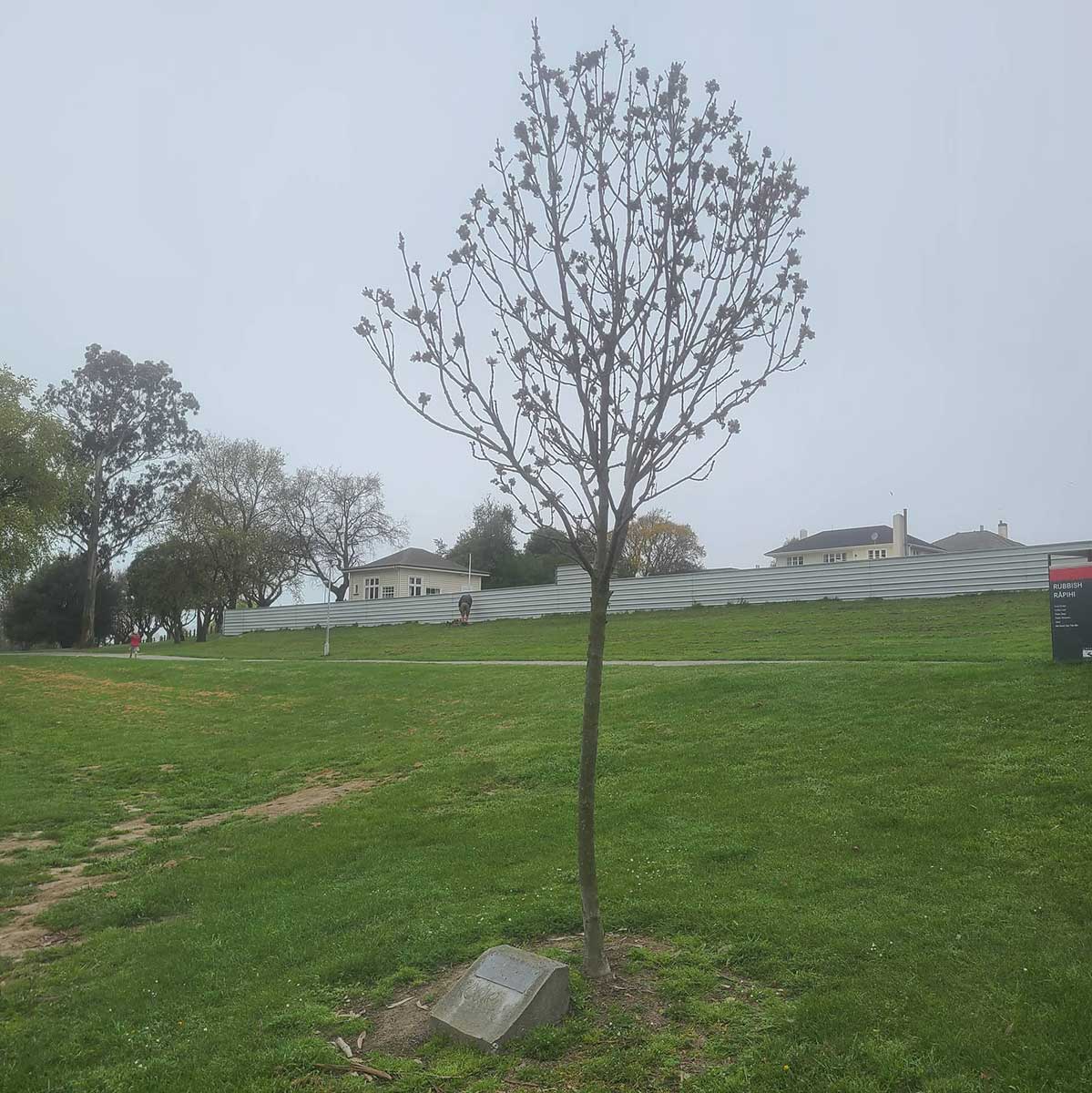
On 8th July, 2010 the Woollcombe Ash tree was removed from Asbury Park. It was no longer structurally sound and children were playing in and around the tree. Recently the external circumference of the tree had decayed further so that it was only alive in two or three thin sections. It was the first ash tree planted in Timaru. A replacement ash is to be planted at the site.
Timaru Herald, 11 June 1914, Page 7 A FORTNIGHT'S JOURNEY.
CHRISTCHURCH TO TIMARU. In 1861 the late Captain Woollcombe brought his bride from Christchurch and the journey occupied a fortnight. Miss Woollcombe told a representative of the "Herald" some of the adventures they experienced, as she had heard the story from her mother. They set forth from Christchurch with a bullock dray, two bullock drivers, a dog cart towed behind the dray, and a dog. They had great trouble with the rivers, and the dog cart breaking its axle, had to be brought most of the way on the dray. The Geraldine Creek was to high for them to cross, and a stay of several days had. to be made with Mr Alfred Cox, of Raukapuka. When at last they reached their home at Waimataitai it was impossible to use the dog cart because the road from there to Timaru would not allow it to be used. Journeys to the settlement or to distant neighbours were not made then by the road so often as in a direct line "across country." When the Woollcombes' present house was being built, Bishop Harper had occasion to hold a meeting at Mr Herbert Belfield's house, on the adjoining hill, and the foundations of the Woollcombes' dwelling were taken to serve as chairs for the assemblage. Mr Belfield, who was afterwards proprietor of the "Herald," was the first milkman of Timaru, carrying the milk himself, so simple were the times, in two large vessels.
Death: WOOLLCOMBE - On July 22nd, at his residence, Ashbury, near Timaru, Captain Woollcombe, R.N.; aged 75 years.
Obituary page 3
Another old identity, Captain Belfield Woollcombe, passed away very suddenly on Tuesday night, being nearly seventy-six. He had been seized with a fatal stroke of apoplexy, or heart failure. Dr Hogg was sent for.
Captain Woollcombe was one of the oldest settlers in South Canterbury, he had been engaged in many public capacities. He was born 1st January 1816, in Pellerton (North Tawton), on the borders of Devon and Cornwall, of which his father, the Rev. Henry Woollcombe, was Rector. The family presently moved to High Hampton and Ashbury, after which latter place the deceased named his residence near Timaru. Losing his father when he was but two or three years old, the future naval officer and colonist was brought up by his grandmother Lady Louis, until he was thirteen, at which age he entered the Royal Navy, 26th Nov. 1829, as a midshipman on board the H.M.S. Thunderer, and his memory carried him back to the demonstrations on board, in 1830, while the vessel was in the West Indies, in respect for the death of George the Fourth, and the immediately succeeding demonstrations in honour of the accession of William the Fourth. Later he took part in the "Opium War" with China, of 1839-42, for his services he received a medal. Promoted to lieutenant 8th June, 1841. The later portion of his naval career, which closed in 1850, was spent as Staff Lieutenant at Plymouth, under his uncle Admiral Sir John Louis. After completing 21 years service Lieutenant Woollcombe retired from the Navy, with the service pension. Subsequently he was ranked as commander, and still later as Post-Captain. He came to New Zealand in 1852, and became a partner with Messrs Lee, Mallock and Lance (all well known names) on the "New Zealand Wool Growing Company" at Mount Parnassus, in the Nelson Province, just over the Canterbury boundary. In October, 1857, Lieut. Woollcombe came to Timaru, and buying a small section whereon he has since lived, he built himself a small whare, which still stands to attest the honesty and thoroughness of his handiwork. At the time of his arrival there were only one or two dwellings on the site of Timaru, occupied by the late Sam Williams and Captain Cain (if indeed the later had then come here.) The country was however being rapidly taken up as sheep runs, and there was a good deal of travelling to and fro, and already some wool to be shipped by whale boats of from the beach. Lieut. Woollcombe was appointed Government Agent at Timaru, a multifarious office, which he held for some years and which required him to be by turns Resident Magistrate, Immigration Agent, Post-Master, Customs Officer, Harbourmaster, Beachmaster, Pilot, Register of Births, Marriages, and Deaths, and Health Officer. His naval experience was brought into play in the survey of the Timaru harbour, which is often appealed to as a standard survey. When the town and district increased in population these duties were divided among other officers. Lieut. Woollcombe retaining the post of Resident magistrate, adding to it that of returning Officer. He held the Resident Magistrateship till September 1878, when he relinquished it and was succeeded by Mr Richmond Beetham. Since then he has frequently sat on the Bench as a Justice of the Peace. Captain Woollcombe has always taken a keen interest in the harbour question, and lately had been a useful member of the harbour board. In every aspect he was the father of Timaru. Beside his official duties his work as a member of the Anglican congregation deserves special attention. He has not only been a pillar of the church; he was the architect of the first church of St Mary, and did a good deal of work upon it with his own hands, and the energy and Christian zeal thus displayed at the outset has been maintained to the last, he having been the Incumbent's Churchwarden for many years. In December 1878 on leaving the Bench, he entered into partnership with Mr George Clulee, and up to the very day of his death took an active share on the work of the well-known firm.
The deceased married a daughter of the Rev Mr Fendall, of Fendalltown, near Christchurch, and leaves to mourn for him, besides the widow (who is unfortunately an invalid) one son and five daughters. The son is in the Eastern Extension Telegraph Co. in Sydney the eldest daughter is married to Mr Bradshaw, of the Hook, and the other three daughters are at home. The funeral will take place on Saturday afternoon, at an hour to be advertised tomorrow.
Timaru Herald Friday July 24th 1891 Funeral Notice
The friends of the late Capt. Woollcombe, R.N., are respectfully informed that his Funeral will leave his late Residence, Ashbury, Waimataitai, near Timaru, on Saturday, the 25th instant, at 2 p.m. arriving at St. Mary's Church at about 2.30 p.m. J.E. Beckingham, Undertaker
Timaru Herald Monday July 27 1891
The funeral of the late Captain Woollcombe took place on Saturday afternoon, and was largely attended. The coffin was first taken to St. Mary's Church where the funeral service was performed by the Ven. Archdeacon Harper, and then, about 3 p.m. the cortege started for the cemetery. The hearse was followed by two close carriages, and an open one containing the members of the Vestry of St. Mary's, then came about 50 persons on foot, most of them very old residents of Timaru and districts, and following them about a score of vehicles, containing the townsmen and persons from the country districts. Several business people in Stafford street put up their shutters, expecting the cortege would go along the main thoroughfare, but it was taken by Sophia and Barnard streets to Shepherd's corner.
Timaru Herald July 27th 1891
Correction. The partners in the 'New Zealand Wool Growing Company' at Hawkswood (an adjoining property to Mount Parnassus) were Messrs Woollcombe, Stewart Wortley and Thomas Hanmer. They sold out to Mr J.S. Caverhill, and the present owner of the property is Mr John Mcfarlane. The original owners of Mount Parnaasus were Messrs Edward Lee and Edward Jollie.
P.B. Boulton, Christchurch, 24th July, 1891.