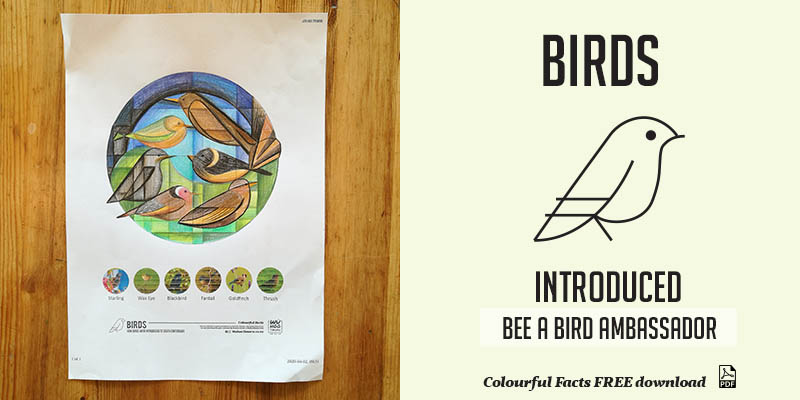
Download:
Colourful Facts Birds - Complex.pdf
Colourful Facts Birds - Simple.pdf

Long before European settlement, Aotearoa's native plants were reproducing with help from native bees, flies, moths, beetles, birds and other animals. Some relied on wind to carry pollen, while ferns reproduced through spores rather than seeds.
European honeybees arrived in 1839, probably first brought by Mary Bumby to Hokianga for honey and wax. As settlers established farms, the bees became valuable for pollinating introduced crops, particularly white clover.
Red and white clover provided nutritious livestock feed and improved soil fertility through nitrogen-fixing bacteria associated with their roots. But producing red-clover seed was difficult. Its deep flowers were particularly suited to long-tongued bumblebees, which farmers hoped would reduce their reliance on imported seed.
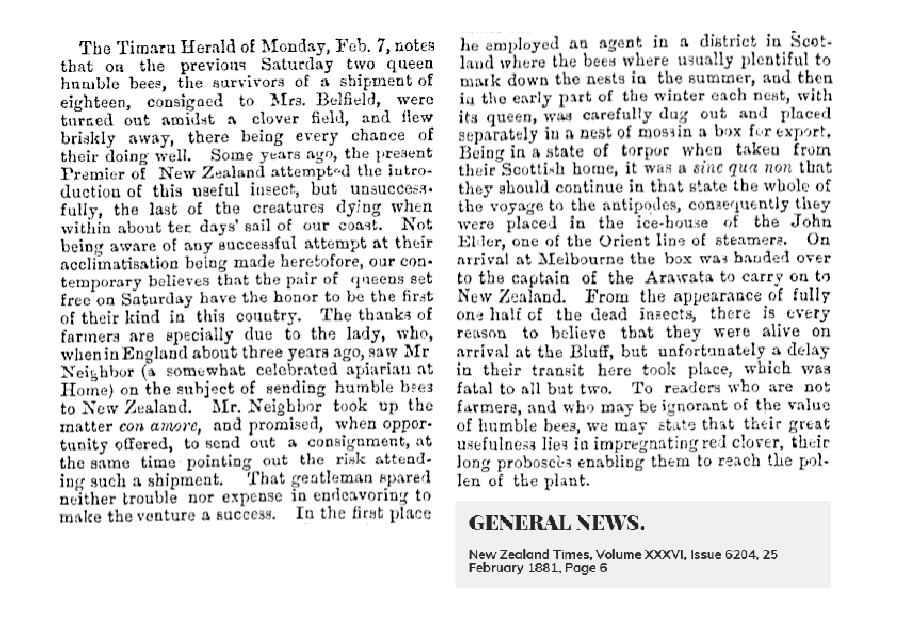
In 1881, Timaru woman Emma Leonora Belfield arranged for 18 bumblebee queens to be shipped from Britain. Only two survived and were released into a clover field near Timaru. According to a contemporary newspaper report, the queens flew away, but there is no evidence they established a lasting population.
Successful introductions followed near Christchurch in 1885. Bumblebees helped farmers produce red-clover seed locally, although honeybees can also pollinate red clover under suitable conditions.
Introduced bees became important to South Canterbury's pasture-seed production, orchards, specialist seed crops and honey industry, including generations of my own Cloake family's beekeeping.
Two histories of pollination. One changing landscape.
Today, introduced honeybees collect nectar from native mānuka and rātā, while native bees and flies visit introduced crops and garden flowers. These relationships support agriculture, but they have also changed our ecosystems.
According to the Department of Conservation, honeybees can compete with native animals for nectar and pollen and increase pollination of some introduced weeds. The effects vary between habitats.
Russell lupins around Lake Tekapo and the Mackenzie Country are a good example. Their colourful flowers attract bumblebees, which collect pollen and can help fertilise the flowers. But the plants have become invasive. Their seeds spread through exploding pods, water and human activity.
Environment Canterbury identifies wild Russell lupin as a declared pest. Dense infestations displace native vegetation, alter the flow of braided rivers and provide cover for predators near threatened birds' nesting sites. Control requires ongoing work and expense.
A plant can be beautiful and useful to pollinators while damaging the wider environment. Likewise, introduced bees can provide valuable agricultural services without replacing the native species that evolved alongside our plants.
What can we learn?
I began this history hunt wanting to understand why my family kept bees. Instead, I discovered two overlapping histories of pollination: one shaped by Aotearoa's native plants and animals over thousands of years, the other by introduced species and the farming systems people established.
Both have shaped South Canterbury. Some introductions brought lasting economic benefits; others created environmental problems we are still paying to manage. Some did both.
Next time you see a flower, look a little closer. What pollinates it? How does it spread its seeds? And what other plants and animals depend on it?
Not everything in nature relies on bees. Understanding how these relationships work, and how people have changed them, can help us make better decisions for the future.
Roselyn Fauth (née Cloake) | WuHoo Timaru
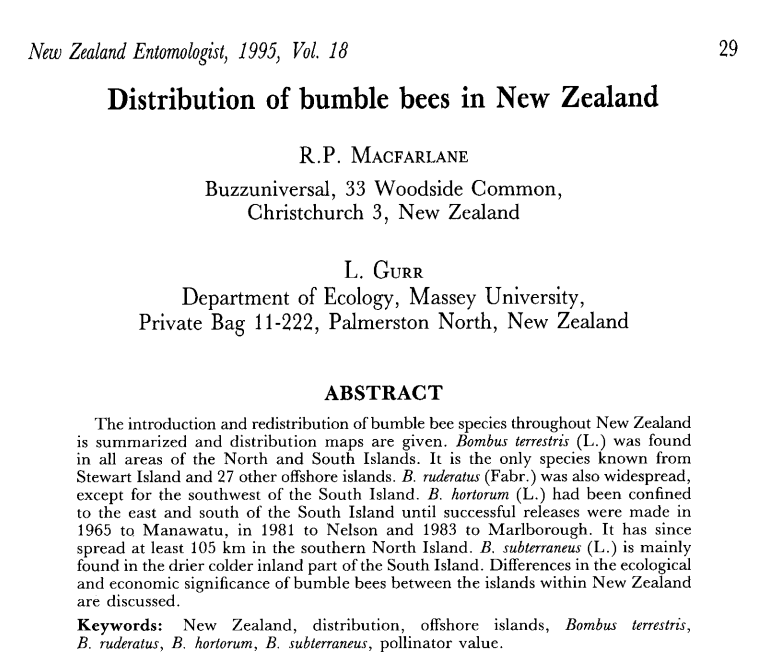
New Zealand Entomologist, 1995, Vol. 18 Distribution of bumble bees in New Zealand New_Zealand_Entomologist_1995_Vol_18_Distribution_of_bumble_bees_in_New_Zealand.pdf
In 1995, entomologists R. P. Macfarlane and L. Gurr published Distribution of bumble bees in New Zealand, investigating how introduced bumblebees had spread across the country. They examined records of more than 28,000 bumblebees visiting over 300 types of flowers. Their research traced the first attempted introductions in 1875–76 and the successful release of 93 queens near Christchurch in 1885. By the time of their study, four introduced bumblebee species were established. They recorded the long-tongued Bombus subterraneus around Orari and Pareora Gorges, Sherwood Downs, Ashwick Flats and Fairlie, while the more widespread Bombus terrestris had been observed foraging as high as 2,500 metres around Aoraki/Mount Cook. Bumblebees originally introduced to pollinate red clover had spread far beyond the paddocks they were intended to help.
What interested me most was how these newcomers had become part of our wider ecosystem. The researchers reported that Bombus terrestris also pollinated at least 53 native plant species, while introduced bumblebees could help weeds such as gorse produce seeds. They were valuable to farming, particularly clover, lucerne and horticultural crops, but their spread also raised conservation questions, especially on offshore islands. The study doesn't establish that bumblebees harmed those native plants, but it shows how introducing one group of insects can create new relationships across an entire landscape. We brought bumblebees to help reproduce introduced crops. More than a century later, they were also visiting native flowers and potentially helping introduced weeds spread. It's another example of our two overlapping histories of pollination.
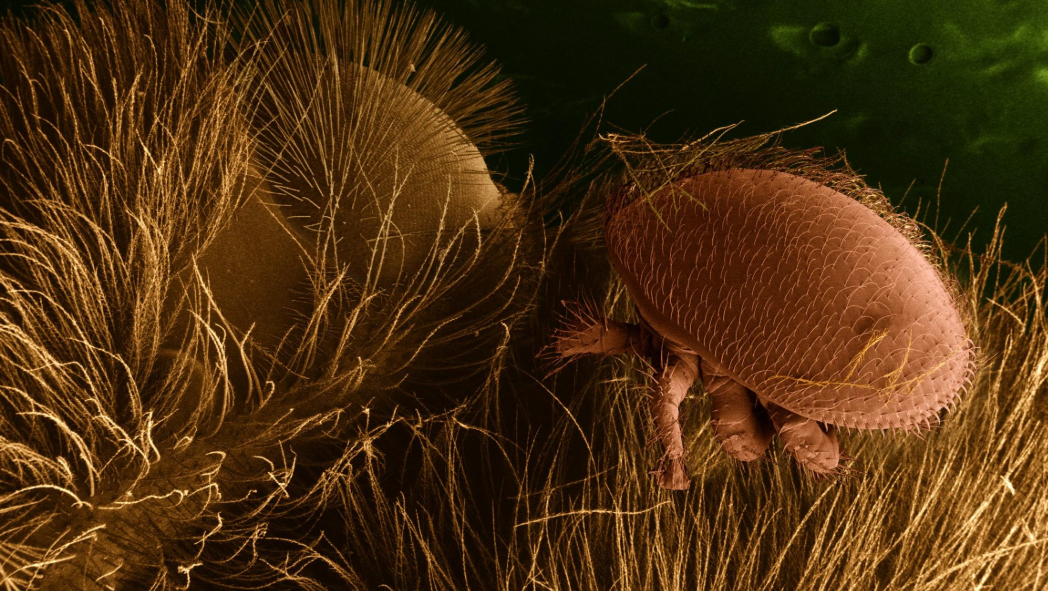
The parasitic varroa mite weakens honeybees and spreads damaging viruses. First detected in New Zealand in 2000, it remains a major challenge for beekeepers. Image: Eric Erbe and Christopher Pooley, USDA Agricultural Research Service. Public domain.
Honeybees arrived in New Zealand in 1839, but one of their most destructive parasites came much later. On 11 April 2000, the varroa mite (Varroa destructor) was discovered in beehives in South Auckland. Nobody knows exactly how it entered the country, and it may have been here unnoticed for several years. By 2006 it had reached the South Island and has since spread throughout mainland New Zealand. The Chatham Islands remain free of the mite. Measuring just 1–2 mm across, varroa feeds on honeybees' body tissues and spreads harmful viruses, weakening bees and eventually killing untreated colonies. It primarily affects honeybees, rather than our native bees or introduced bumblebees. Beekeepers must now regularly inspect and treat their hives, adding significant costs to honey production and crop pollination. It is another reminder of how an introduced organism can permanently change our environment, and why protecting New Zealand from new pests and diseases matters.
The tiny mite that changed New Zealand beekeeping - varroa was confirmed in North Canterbury in September 2008, but a report in the New Zealand BeeKeeper magazine in June 2009 stated that no mites had yet been found south of the Rakaia River. Timaru beekeepers prepared for the approaching mite, and The New Zealand BeeKeeper reported on a varroa training workshop held in Timaru on 6 June 2008. Beekeepers from across the southern South Island attended to learn how to recognise and control the parasite. https://beekeeping.nz/NZBDA/NZBkpr/2008_07_NZBkpr.pdf
By 28 November 2016 veroa was here. Beekeeper Reece Adamson reflected on the arrival of varroa in Otago and Southland during 2011–12, recalling the adjustments beekeepers had to make. Here is a firsthand account of the mite's southward spread: https://www.odt.co.nz/news/sticking-at-it-the-secret-to-success-in-a-sticky-business-k19nwiw6
After learning how our native plants reproduced before honeybees arrived in 1839, I began wondering what would happen if they disappeared.
Our native forests wouldn't suddenly die, and we wouldn't run out of food. But some of the farming systems we've developed over nearly 190 years would face serious difficulties.
Honey production would stop, and crops would suffer. Without honeybees, New Zealand's commercial production of mānuka, clover and other honeys would effectively cease. Beekeeping businesses, including those built by generations of my own Cloake family in South Canterbury, would be affected.
The consequences would extend well beyond honey. Honeybees pollinate many of our apples, cherries, kiwifruit and vegetable seed crops. They are particularly important for producing white-clover seed, used to establish the pastures that feed sheep and cattle.
While researching this, I found a fascinating local example in the New Zealand Journal of Agriculture, January 1959. The Department of Agriculture recorded 470 beehives across 30 apiaries between the Pareora and Ōtaio rivers, an important white-clover seed-growing district. Researchers believed there were too few hives to achieve maximum seed production.
Today, the Foundation for Arable Research recommends at least two strong honeybee hives per hectare for effective white-clover seed pollination. Without honeybees, seed growers would need other pollinating insects or alternative methods, potentially reducing yields and increasing costs. Not every crop would suffer. Wheat, barley and oats are mainly wind- or self-pollinated. Established clover plants could continue growing and spreading, but producing new seed would be more difficult.
Would our native plants survive?
Yes, many would. Aotearoa's native plants were reproducing long before honeybees arrived. Native bees, flies, moths, beetles and birds would continue pollinating flowers. Wind-pollinated trees such as tōtara and native beech would reproduce, while ferns would continue producing spores. Some plants might produce fewer seeds where introduced honeybees now contribute to their pollination. Others could benefit from less competition for nectar and pollen. According to the Department of Conservation, honeybees can compete with indigenous animals for floral resources and help pollinate invasive weeds. The effects vary between species and habitats. If all bees disappeared, including native bees and bumblebees, the consequences would be greater. Other insects and birds could still pollinate many plants, but they couldn't necessarily replace every bee's work.
Are honeybees at risk of disappearing?
Honeybee extinction is not an immediate prediction, but keeping colonies healthy requires constant work. The Ministry for Primary Industries' 2025 Colony Loss Survey estimated that 12.8% of managed honeybee colonies were lost over winter, with the parasitic varroa mite the leading identified cause. These are colony losses, not evidence that the species is approaching extinction. Beekeepers can establish replacement colonies, but losses increase their workload and costs. Meanwhile, scientists are investigating how native bees, flies and other insects can contribute to commercial crop pollination, supported by suitable habitats and flowering plants.
What have we learned?
I started this history hunt wanting to understand my family's beekeeping past. I've discovered how native plants reproduced before honeybees arrived, why people introduced new pollinators and how dependent some of our agricultural industries have become on them. We've developed farming systems that rely heavily on managed honeybees. Yet our native plants remind us that pollination involves many species, each with different roles.
Honeybees are important to our economy, but they are not the only pollinators that matter.
Protecting them means managing pests and diseases and ensuring they have suitable food sources. Protecting native pollinators also means caring for indigenous vegetation, nesting places and the relationships that developed here long before European settlement. Next time you see an insect or bird visiting a flower, look a little closer. It might be helping produce our food, regenerate native forest or spread the next generation of plants.
Understanding those connections gives us another reason to look after the places we share.
Roselyn Fauth (née Cloake) | WuHoo Timaru
Research sources include the Museum of New Zealand Te Papa Tongarewa, Department of Conservation, Environment Canterbury, New Zealand Plant Conservation Network, Papers Past (National Library of New Zealand), and scientific research published in the New Zealand Journal of Botany. Te Papa lists these watercolours as having no known copyright restrictions, but it's still worth following its image-use guidance.
1. Sarah Featon and The Art Album of New Zealand Flora (Te Papa) https://www.tepapa.govt.nz/the-art-album-of-new-zealand-flora
2. Sarah Featon's illustration of five hebes (Te Papa) https://collections.tepapa.govt.nz/object/310850
3. Sarah Featon's horokaka and kōkihi illustration (Te Papa) https://collections.tepapa.govt.nz/object/550198
4. New Zealand's Native Bees: Quiet Lives of Desperation (Te Papa, Julia Kasper, 2021) https://blog.tepapa.govt.nz/2021/02/01/new-zealands-native-bees-quiet-lives-of-desperation/
5. New Zealand Plant Conservation Network: native plant identification and ecology https://www.nzpcn.org.nz/
6. W. B. Johnston, Locating the Vegetation of Early Canterbury: A Map and the Sources (1961) https://paperspast.natlib.govt.nz/periodicals/TRSBOT19610916.2.2
7. Howell and Jesson (2013): The Effect of Bird and Bee Visitation on Pollination and Reproductive Success in Harakeke
https://doi.org/10.1080/0028825X.2013.772904
This study compares how effectively birds and honeybees transfer pollen on harakeke.
Taylor & Francis Online
8. Lynda Delph (2022): Functional Precocious Protogyny in New Zealand Sun Hebes https://doi.org/10.1080/0028825X.2021.1936574 Examines hebe flower reproduction and records native flower beetles transferring pollen. Published online in 2021 and in the journal's 2022 volume.
9. Department of Conservation: Tī kōuka / cabbage tree. https://www.doc.govt.nz/nature/native-plants/cabbage-tree-ti-kouka/
10. Department of Conservation: Mānuka and kānuka https://www.doc.govt.nz/nature/native-plants/manuka-kahikatoa-and-kanuka/
11. Department of Conservation: Native ferns and their reproduction https://www.doc.govt.nz/nature/native-plants/ferns/
12. New Zealand Plant Conservation Network: Creeping fuchsia https://www.nzpcn.org.nz/flora/species/fuchsia-procumbens/
Introduced bees and changes to New Zealand's environment
13. Historical account of Emma Belfield's 1881 bumblebee introduction, reprinted in the New Zealand Journal of Agriculture (1916) https://paperspast.natlib.govt.nz/periodicals/NZJAG19160821.2.18
14. Timaru Herald, 26 July 1876: Emma Leonora Mellish and Herbert Belfield's marriage notice https://paperspast.natlib.govt.nz/newspapers/THD18760726.2.5
15. Department of Conservation: Honeybees on conservation land https://www.doc.govt.nz/our-work/honeybees-on-conservation-land/
16. Environment Canterbury: Wild Russell lupin https://www.ecan.govt.nz/pest-search/wild-russell-lupin